A Padar Island sunrise mindful hike is the act of ascending Padar’s stepped ridge trail before dawn — not to check a panorama photograph off a list, but to move deliberately through the landscape, settle the nervous system before the heat arrives, and arrive at the three-bay viewpoint with enough stillness to actually absorb what you are looking at. It is one of the few land-based wellness practices inside Komodo National Park that costs less than a spa session and asks only your attention and your legs in return.
That framing matters because Padar is routinely packaged as a pure photography stop: pre-dawn alarm, sprint to the ridge, golden-hour shot, back to the boat. That version of the hike is real and valid. But it skips almost everything that makes the climb worth doing slowly. This guide is for people who want the other version.
What Makes Padar Different From Other Komodo Treks
Padar Island sits roughly in the middle of the Komodo National Park archipelago, between Komodo Island to the north and Rinca to the east. It is uninhabited. No Komodo dragons have been recorded there in recent surveys, which means you are not required to hike with a ranger escort on Padar the way you are on Komodo and Rinca — though conditions can change, so confirm this with your operator before you disembark.
The island’s topography is severe in a way that photographs flatten. The ridge trail climbs roughly 170 metres above sea level in under a kilometre of trail distance. That gradient is not dangerous for a person in reasonable health, but it is sustained. There are constructed wooden steps for much of the ascent. The steps are irregular in height and spacing, and some sections are loose gravel between the wooden battens. At pace, the climb takes 20 to 40 minutes. Slowly — the mindful trekking komodo way — it can take 50 minutes to an hour. Neither is wrong.
What makes the hike genuinely unusual as a wellness experience is the sensory environment. The island is dry, almost scrubby — one of the driest micro-climates in Indonesia, receiving roughly 800 to 1,000 mm of rainfall per year across the wider park. The vegetation is open savannah and sparse dry forest. There is no canopy. On a still morning, before the other boats arrive, the loudest sounds are water, wind, and birds. That silence is not a given in peak season. In July and August you may share the trail with dozens of other hikers. More on that shortly.
The Realistic Early Start: Getting to the Anchorage
Padar does not have a harbour. You anchor offshore and transfer to the beach by tender or by the ship’s dinghy. The anchorage is in a sheltered bay on the island’s south side. Most boats position themselves there the evening before, either motoring up from Labuan Bajo overnight or anchoring after afternoon diving.
The pre-dawn start is not optional if you want the sunrise experience. Nautical twilight at this latitude (approximately 8°40’S) begins around 05:00 – 05:15 depending on the month. First light crests the eastern ridgeline between 05:30 and 06:00. Allowing 50 to 60 minutes for a deliberate ascent means you need to be on the beach by 04:30 at the latest. That translates to a 04:00 or 04:15 wake-up call aboard, depending on how your operator runs the tender transfers.
Some people find that pre-dawn start to be itself part of the mindfulness practice. There is something clarifying about moving in near-darkness, navigating by headtorch, hearing the water before you see it. Others find it simply uncomfortable. Both responses are honest.
One practical detail that is easy to underestimate: the tender transfer in darkness from a phinisi to a small beach requires reasonable balance. Seas in the sheltered anchorage are usually calm, but swell can enter the bay on some wind directions, particularly during the southeast monsoon (June to September). Ask your skipper the evening before whether conditions look settled. Reef sandals or watershoes are more useful than hiking boots for the wade ashore.
SiOra Booking and the Daily Visitor Cap
Access to Komodo National Park — including Padar — is now managed through the SiOra system (Sistem Informasi Online Reservasi Wisata Alam). This replaced walk-up harbour tickets from 2026. The system allocates time slots and ties permits to individual passport numbers.
The current pilot structure divides the day into three sessions: 06:00 – 11:00, 11:00 – 15:00, and 15:00 – 18:00. A daily cap of approximately 1,000 visitors across all zones is in operation across the park as a trial from early 2026 — described by at least one operator as not yet a finalised permanent policy [VERIFY current cap and session structure directly with your operator before booking; this is described as a pilot]. Each session notionally accommodates around 333 people across the entire park, not just Padar.
For the sunrise hike specifically, you want the 06:00 session. In peak season (July and August), that session can fill weeks or months in advance. Operators recommend booking two to four months ahead in peak season, four to eight weeks in shoulder season. Your operator handles the SiOra reservation on your behalf for a liveaboard or charter; independent travellers need to book through the system directly, which requires a registered account and passport details.
The permit is non-transferable and tied to a specific date. Losing a day to weather, engine trouble, or a schedule change means losing the permit and re-booking — a real logistical consideration when planning around a sunrise window. Build flexibility into your itinerary if the hike is a priority.
- Park entry fee (foreign nationals)
- IDR 250,000 per person per day
- Harbour fee
- IDR 25,000 per person per day
- Diver surcharge (if diving same day)
- IDR 25,000 per person per day
- Typical total per-day cost (foreign non-diver)
- IDR 275,000
- Typical total per-day cost (foreign diver)
- IDR 300,000
- Trail ascent time (moderate pace)
- 20 – 40 minutes one way
- Trail ascent time (mindful pace)
- 50 – 60 minutes one way
- Elevation gain (approximate)
- ~170 metres
- SiOra sunrise session window
- 06:00 – 11:00
- Peak booking lead time
- 2 – 4 months (July – August)
Park fees are consistent across multiple operator and travel sources as of 2025 – 2026 but are not drawn from an official Indonesian government primary document. Verify with your operator before travel.
The Three-Bay Viewpoint: What You Are Actually Looking At
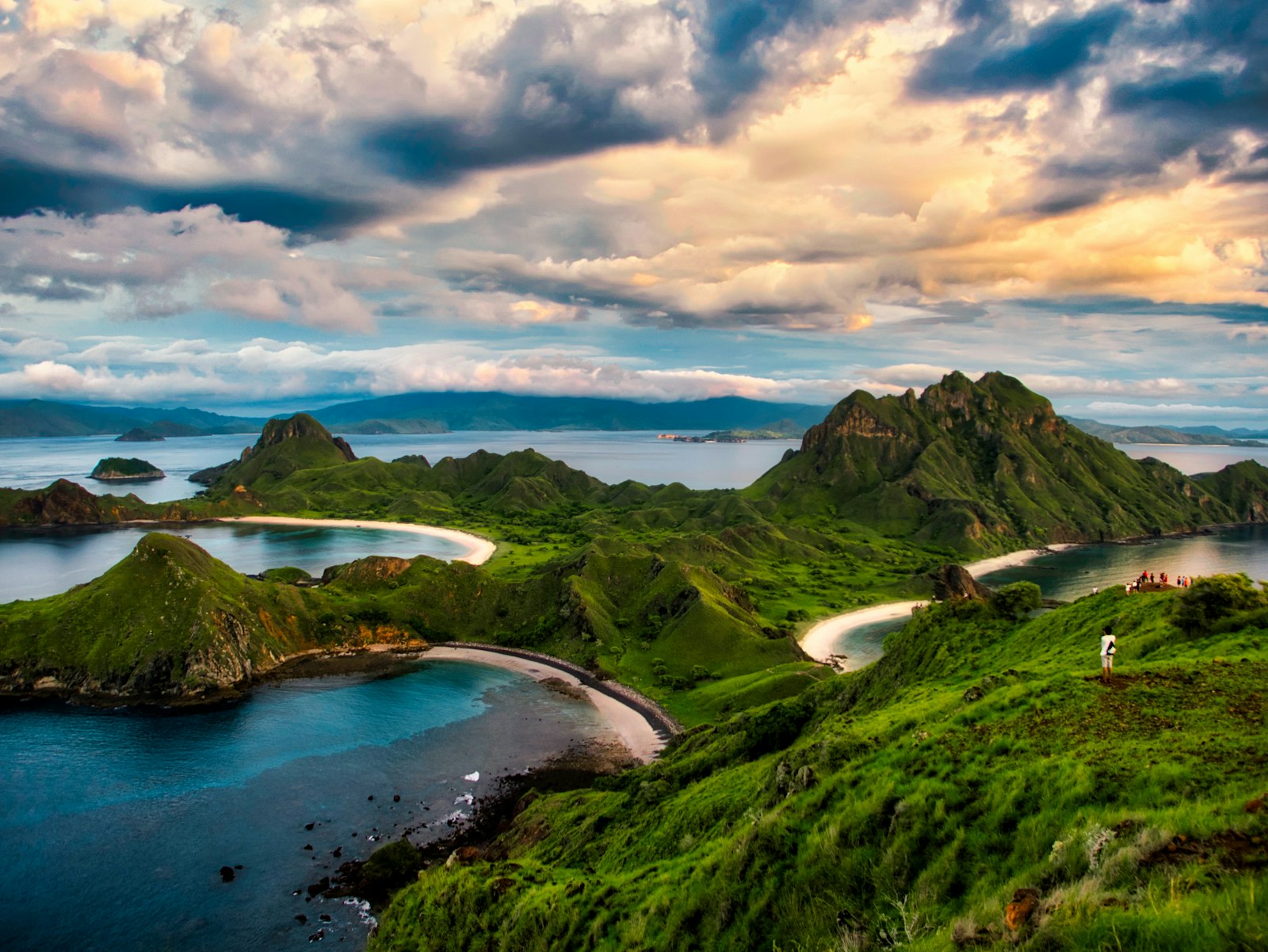
The classic photograph from Padar’s ridge shows three bays in the same frame: one with a white-sand beach on the island’s south side, one with dark volcanic sand to the northwest, and one with pink-tinged sand — the same coral-fragment sediment that gives Pink Beach its name — to the east. The colour contrast between the bays is real, not post-processed, though camera settings and light angle affect how dramatically it reads in any given shot.
At sunrise, the light comes from the east, behind you if you are facing the white-sand bay. The sea south of Padar catches the colour first. The hills north of the island go from black silhouette to grey-green. It happens in a sequence over about 20 minutes rather than all at once, which is one reason arriving early and staying still — padar viewpoint meditation is a reasonable description of what this can be — rewards patience in a way that rushing up and rushing back never does.
The viewpoint itself is a narrow ridge saddle. There is a low safety rail on the steepest drop-off side. In peak season, the area fills quickly. On a busy July morning you may be sharing the ridge with 30 to 50 other hikers from boats anchored overnight. The experience is genuinely different from a quiet April morning when there might be ten. Neither is advertised dishonestly, but the difference matters if solitude is what you are seeking.
Approaching the Hike as a Mindful Movement Practice
Mindful trekking komodo style does not require a yoga background or any particular spiritual framework. It is simply the practice of paying close attention to what is already happening. On the Padar trail, that means a few concrete things.
Breath and Cadence Before the First Step
Before you leave the beach, pause for two or three minutes. Not a structured breathing exercise — just a stop. Let your eyes adjust if it is still dark. Note the temperature (it will be noticeably cooler at this hour than at midday; lows in June through August can drop to around 21 – 22°C at the coast). Feel the sand underfoot. This is the practice beginning, not a preamble to it.
On the trail itself, set a pace where nasal breathing is comfortable without effort. If you are breathing through your mouth and cannot string words together, slow down. The steps vary in height; your cadence will be irregular. That irregularity is useful — it forces present-moment attention in a way that a flat treadmill does not. You cannot zone out on loose steps in the dark.
The Rest Points as Practice Anchors
There are two or three natural rest points on the trail where the gradient eases and a wider flat area gives you somewhere to stand comfortably. Most hikers push through these. Use them differently. Stop for 60 seconds. Look down the slope you just climbed. Notice what has changed in the light since you started. The Komodo National Park landscape at this hour has a specific quality — the savannah grass is a pale silver-green, the sea below is dark blue-black, and the sky near the horizon is a band of colour that has no exact English name, somewhere between ash and amber.
These rest points are also where you will hear the difference between the island’s silence and the boat sounds drifting up from the anchorage. Both are part of where you are.
At the Viewpoint: Sitting Before the Camera
This is the one practical suggestion that seems to make the most difference: sit down before you photograph anything. Find a spot on the ridge — even a narrow one — and sit for five full minutes. Let the scene register through your eyes rather than through a screen. The photograph will still be there when you pick the camera up. The moment of actually seeing it, without intermediation, is harder to recover once you have given it away to the viewfinder.
This is padar sunrise wellness in its most accessible form: not a programme, not a scheduled session, just the deliberate refusal to immediately convert an experience into content.
Heat, Sun Exposure, and Physical Realities
Padar is one of the driest, most exposed treks in the national park. Once the sun is above the ridge — typically within 30 to 45 minutes of sunrise — the trail receives direct overhead sun with no tree cover. The temperature in September through November peaks between 35 and 37°C. Even in the cooler months of June through August, a midday descent in direct sun is a very different experience from the pre-dawn ascent.
These are the practical notes, presented as information rather than instruction:
- Water: the ascent and descent takes one to two hours total at a mindful pace. Carry at least one litre per person. There is no water source on the island.
- Sun protection: the descent happens in direct sun. Long-sleeved lightweight UV shirts outperform sunscreen application alone on a trail where you are sweating.
- Footwear: the wooden steps have a grip surface, but some sections between steps are loose gravel or dry soil. Trail shoes or grippy sandals with heel support handle the descent better than flip-flops.
- Fitness: the trail is described as moderate. People in average fitness who exercise several times a week manage it without difficulty. People who have not exercised in months may find the gradient challenging, particularly under heat. This is not a technical climb, but it is a real one.
- Medical context: Labuan Bajo’s hospital (RSUD Komodo) handles basic emergencies. Serious conditions require evacuation to Bali or Jakarta. Comprehensive travel insurance with medical evacuation cover is standard practice for travel in this region.
If heat sensitivity, cardiac conditions, or joint problems are relevant for you, the trail’s gradient and exposure are worth discussing with a medical professional before travel. That is factual information about the trail, not a reason to avoid it.
Crowding in Peak Season: An Honest Picture
Padar is one of the most photographed sites in Indonesia. In July and August, the anchorage below can hold dozens of boats, and the 06:00 session fills with hikers from liveaboards that have all positioned for the same sunrise window. The ridge viewpoint is narrow. Getting a clean photograph without other people in the frame requires either an extremely early position or significant post-processing.
This is not a criticism of other hikers. It is simply a useful thing to know before you plan around a vision of solitude that the peak months do not reliably deliver.
The quieter windows — for both the hike and the broader padar sunrise wellness experience — are April through early June and September through October. April to June in particular is one of the best windows across multiple liveaboard and wellness operator assessments: the landscape is greener from the wet season recently past, seas are calmer, and visitor numbers are markedly lower. You are still subject to the SiOra slot system, but the 06:00 session does not fill as pressingly far in advance.
If you are reading this and planning a trip specifically around the mindful experience rather than the peak-season social calendar, the shoulder seasons are worth building your dates around. Our best-time guide covers the seasonal tradeoffs across the full park in detail.
What to Carry: The Short Version
The full packing guide covers a complete trip. For the Padar hike specifically, the list is short:
- Headtorch with fresh batteries (not a phone torch — you need your hands free on the steps)
- At least one litre of water per person, more in warmer months
- Light windproof layer for the ridge in June through August (the southeast monsoon creates real wind at elevation; 21°C with wind at 05:00 is cold in shorts)
- Sun protection for the descent: hat, shirt, sunscreen
- Grippy closed-toe shoes or trail sandals
- Small dry bag or dry sack if your tender transfer involves any water splash
Leave the heavy camera bag on the boat unless you have a specific reason. A mirrorless body with a single lens is easier to manage on narrow steps in the dark than a full kit bag.
Integrating the Hike Into a Wider Wellness Day
The Padar sunrise hike works particularly well as the opening movement of a full wellness day aboard a phinisi or charter vessel. The physical exertion — the climb, the ridge, the descent — lands you back on the boat between 07:00 and 08:00, body warm, mind quieter than it was at 04:00, ready for breakfast and then whatever the day holds.
Some operators who run wellness-oriented itineraries — Aliikai’s dive-and-yoga departure format, SeaTrek’s wellness cruise programme [VERIFY current schedules directly with operators] — schedule an onboard yoga or breathwork session after the hike descent rather than before it. That sequencing makes physiological sense: the cardiovascular exertion of the climb functions as a warm-up, the ridge provides the centering moment, and the mat session on deck consolidates both. It is a very different experience from a morning class before movement.
The afternoon following a Padar dawn start is also one of the natural points in a Komodo itinerary to slow down rather than stack activities. Pink Beach is a 20-minute boat ride from the Padar anchorage. Our slow-travel Pink Beach guide covers how to use that afternoon well without defaulting to another photographic sprint.
If you are combining a Padar hike with diving on the same day, note that no-decompression diving after vigorous physical exertion is a consideration worth raising with your dive guide. Most experienced Komodo dive guides apply conservative surface interval standards after strenuous activity. This is a factual operational note, not medical guidance.
A Note on Independent Curation
This guide names operators only as neutral examples to verify. No one has paid to be included here, and inclusion is not an endorsement. If you find this guide useful and choose to plan your trip through a partner operator we introduce you to, they may pay us a referral fee at no extra cost to you. That arrangement never changes what we publish or which operators we mention.
Ready to plan? Use our enquiry form or reach the concierge team directly on WhatsApp at +62 811 382 3875. The team can advise on SiOra booking status, operator options for the date you have in mind, and whether the sunrise session is likely to be pressured during your travel window.
Frequently Asked Questions
How fit do I need to be for the Padar Island sunrise hike?
The trail gains roughly 170 metres over a short distance with constructed wooden steps and some loose gravel sections. People in average fitness who walk or exercise several times a week generally manage it without difficulty, even at a slow pace. It is not a technical climb, but the gradient is genuine — not a gentle stroll. If you have significant knee, hip, or cardiac concerns, the exposed descent in post-sunrise heat adds to the physical demand. Treat this as information to factor into your planning rather than a barrier; consult your own medical context before travel.
Do I need to book the Padar sunrise hike separately, or does my liveaboard handle it?
Most liveaboard and charter operators handle SiOra permit booking on your behalf as part of the trip package. The permit is tied to your passport number and the specific date, so your operator needs your passport details in advance — sometimes weeks or months ahead in peak season. Independent travellers need to book through the SiOra system directly. Confirm the booking process with your operator when you make your initial reservation; do not assume it is included until you have it in writing.
Will it be crowded at the top?
In July and August, yes — potentially crowded. The Padar viewpoint is the single most photographed spot in Komodo National Park, and the 06:00 sunrise session draws liveaboards from across the anchorage simultaneously. In April through June and September through October, the same session is noticeably quieter. If a private ridge moment is important to you, the shoulder seasons are the more reliable choice.
Can I do the Padar hike without a ranger?
Padar Island does not currently require a ranger escort for the ridge trail, unlike Komodo Island and Rinca where dragon encounter risk makes a ranger mandatory. However, park rules and access conditions can change, and the SiOra daily cap may apply operational constraints that affect how access is managed. Confirm the current requirement with your operator before you disembark — this is one of those details that is accurately described as subject to change.
What is the best month for a mindful Padar sunrise experience?
April through early June stands out across most wellness-oriented operator recommendations: the landscape retains green from the wet season, seas are calm for the anchorage approach, air temperatures at dawn are comfortable rather than cold, and visitor numbers are lower than peak. September and October are a strong second window — excellent marine conditions, fewer boats than July and August, and a dry, clear sky at sunrise that rivals the peak season without the crowds. The SiOra slot still needs advance booking, but the pressure is less acute than high summer.