
How to read this: Komodo Wellness Retreat is an independent curation guide for wellness travel in the Komodo & Flores region — we compare retreat styles (yoga, meditation, detox, dive-wellness, liveaboard, spa) and then route your enquiry to a vetted partner who handles the booking. We are not a resort, operator, studio or booking platform, and any property or place names are neutral examples only, not claims of affiliation or endorsement. Wellness content here is general information, not medical, health or fitness advice — consult a qualified professional before any detox, fasting, diving or new practice. Park permits, fees, schedules and the ~1,000/day Komodo National Park visitor cap change — confirm current details before you travel. Prices are by quote and vary by retreat, season and group; figures here are indicative ranges only.
A meditation retreat on Komodo Island is not the same thing as a Vipassana centre in Chiang Mai or a silent ashram in Ubud. No dedicated silent-retreat facility with a resident teacher, structured daily schedule, and noble-silence rules has been confirmed operating in Komodo National Park or anywhere in the wider Flores region as of mid-2026. What genuinely exists here is something different and, for the right traveller, arguably more resonant: a landscape so geologically raw and so quiet at anchor that formal practice feels almost redundant. Understanding that distinction before you book will save you disappointment and may, if the setting matches what you are seeking, save you money compared with a packaged programme that delivers less than it promises.
What “Meditation Retreat in Komodo” Actually Means
Search for a mindfulness retreat in Komodo and you will find booking aggregators listing dozens of packages, most of which resolve, on closer inspection, to Bali-based operators who include Komodo as a two-day extension, or to directory pages with zero confirmed listings for the region. Retreat platforms such as BookYogaRetreats show zero packages for Komodo Island. BookRetreats lists Flores retreats, but independent verification of the actual properties places most of them in Lombok or Sanur, not on Flores or inside the park.
That is a candour point worth stating plainly, because the decision it leads to is genuinely useful: if you need a structured daily programme with a qualified teacher, assigned sitting periods, and the social container of a silent retreat, Bali remains far denser in that offering at every price point. If what you need is slower pace, oceanic silence, and a natural environment that does the work that a teacher might otherwise do, Komodo delivers that with very few rivals in the Indonesian archipelago.
The Distinction That Matters
A marketed “mindfulness add-on” — a single guided breathing session before breakfast on a liveaboard, or one optional yoga-and-meditation class offered twice a week at a resort — is a wellness amenity. It is not a meditation retreat in the classical sense. Several reputable operators in the Komodo region do include meditation sessions within broader wellness programmes [VERIFY individually with each operator before booking], and those sessions can be genuinely valuable. But calling them a retreat, in the sense of an immersive container designed around contemplative practice, would misrepresent what they are.
The honest frame is this: Komodo and Flores offer one of the best natural environments in Southeast Asia for solo or self-directed practice, and a small but growing number of operators weave structured sessions into liveaboard and resort formats. Neither replaces a purpose-built retreat centre. Both can be extraordinary.
The Natural Setting: Why This Place Works for Mindfulness
Komodo National Park covers roughly 1,817 square kilometres of marine and terrestrial habitat across the Lesser Sunda Islands. Annual rainfall in the park itself runs to approximately 800–1,000mm — one of the driest zones in Indonesia. Average humidity sits around 36%, which is unusually low for the tropics, and in the dry season (April through October) the air has a clarity that is physically different from Java or Bali. You feel it on the skin.
For nature meditation in Flores, the practical implications are significant. You are not managing sweat-soaked clothing or a mind fogged by equatorial humidity. Sitting still on a phinisi deck at first light, with Rinca’s ridgeline turning from charcoal to amber, costs nothing in physical discomfort. The environment cooperates.
Quiet Anchorages
The park has scores of named anchorages and many more unnamed ones. After the day’s dive boats return to Labuan Bajo harbour, the bays around Padar, Gili Lawa Darat, and the northern channels empty out. By 17:00 in shoulder season, a liveaboard anchored off a beach on Pulau Kalong might share the horizon with two or three other vessels. By 20:00 it may have the bay to itself. There is no road noise. There is no ambient light pollution. The silence is not metaphorical.
This is not guaranteed — July and August bring peak crowds, and some bays near popular dive sites see constant boat traffic during the day — but in the April–June or September–November windows, the quieter anchorages are genuinely quiet in a way that anchors mindfulness without any instruction at all.
Padar Island at Dawn
The Padar summit trek is one of the most cited mindfulness retreat Komodo experiences, though nobody calls it that. The walk takes roughly 30–45 minutes from the beach landing, and it is genuinely steep in sections. The summit at sunrise — three bays visible simultaneously, the light moving from blue-grey through rose to gold — produces a quality of attention that most people describe as the closest they have come to meditation without sitting on a cushion. There is a practical planning note: the SiOra digital booking system now manages visitor quotas for the park, with three time slots beginning at 06:00. In peak season (July–August), early slots fill weeks in advance. April–June gives you a sunrise slot with far less competition.
Stargazing as Practice
The Komodo area sits well outside the light-pollution radius of any major Indonesian city. On a moonless night in mid-dry season, the Milky Way is not a faint smear but a structural feature of the sky. Samara Liveaboard, among others, mentions stargazing as a component of their wellness charters [VERIFY current programme with operator]. Whether or not it is formally facilitated, lying on a phinisi deck looking at the galactic centre while the boat moves gently at anchor is about as close to open-awareness practice as most people get without instruction.
Operators with Meditation or Mindfulness Sessions: What the Evidence Shows
The following are named neutrally as examples with verified or partially verified programmes. None is endorsed over another. All programme details should be verified directly with the operator before booking, as offerings change seasonally and some are departure-specific rather than part of every itinerary.
Liveaboard Programmes
SeaTrek Sailing Adventures operates what it markets as an “8 Days Life Force Wellness Cruise and Yoga Retreat in Komodo Island” with daily yoga sessions and meditation instruction as core programme elements, combined with snorkelling and park-fee inclusions [VERIFY current 2025–2026 departure dates and pricing directly with SeaTrek before booking].
Aliikai (a purpose-built phinisi liveaboard) hosted a documented “Wander Women Komodo: Dive + Yoga Liveaboard” departure in May 2025, with multiple yoga styles and optional meditation, for a mixed dive-and-yoga group [VERIFY: not all Aliikai departures include yoga; this is a hosted departure model, not a standing daily programme].
Samara Liveaboard offers wellness and yoga charters on request through a private-charter model, with customisable itineraries including onboard yoga instructors and meditation leaders [VERIFY: programme is custom, not a fixed scheduled departure — confirm composition and cost directly].
Cost context for liveaboard wellness in this region: standard shared phinisi tours run roughly IDR 4–7 million total for a three-day, two-night itinerary (approximately USD 130–230 per person per night at current exchange). Wellness-specific or private-charter phinisi with yoga instruction are estimated at USD 350–800 or more per person per night — this range is inferred from comparable Indonesian luxury liveaboard pricing and operator branding, not directly quoted. Confirm by-quote with operators.
Land-Based Resort Programmes
Sudamala Resort, Komodo (Labuan Bajo/Seraya area, TripAdvisor-verified active 2024–2025) markets multi-day wellness packages that include yoga and meditation sessions alongside other activities. Their “Culture and Mindfulness” package is listed at from USD 325 for two nights (was USD 464 per SpaDreams listing data [VERIFY directly with Sudamala for current pricing]) and bundles a yoga/meditation session with a Melukat ceremony, river hot stone therapy, and a spa pool bath. The Sudajiva Spa is a 563 sqm facility with three treatment rooms, open daily 09:00–21:00. The Melukat ceremony is a Balinese Hindu purification ritual — note that this is culturally Balinese, transplanted to a Flores property, not a Flores or Manggarai indigenous tradition.
Katamaran Hotel & Resort Komodo (Labuan Bajo, TripAdvisor “#1 Labuan Bajo yoga hotels”) offers a “Yoga by the Beach” activity and the Soul Bliss Spa [VERIFY current schedule and whether sessions are daily or on request; pricing not confirmed in available data].
Ta’aktana, a Luxury Collection Resort & Spa (Marriott, opened 2024) features the Di’a Spa, a two-storey cave-inspired wellness centre with hot and cold plunge pools, couple’s treatment rooms, and curated regional body rituals. Travel + Leisure Asia noted a rate from USD 490 per night for accommodation [VERIFY for current rates, which fluctuate by season and room category]. Whether meditation or mindfulness sessions are formally programmed is not confirmed in available sources; the spa positioning is treatment-led rather than contemplative-retreat-led.
Sten Lodge Eco Retreat (Melo village, Manggarai Barat, approximately 30 km from Labuan Bajo town) is listed on the YogaFinder directory as offering Pranayama, Yoga Nidra, and Meditation in an eco-homestay format [VERIFY directly — contact: +62 813 3722 9724 — as the listing has not been independently confirmed for 2025–2026 operations]. This is the closest confirmed listing to a dedicated contemplative-practice offering in the Flores region, and it operates in a far more modest format than the beach resorts.
A Realistic Cost Comparison
Setting expectations on cost matters here because the Flores region’s cost premium is driven by remoteness and logistics, not by the density or quality of wellness programming. The table below uses ranges from verified or partially verified sources; single-night pricing varies sharply by season and availability.
| Format | Approximate range | Meditation/yoga included? | Notes |
|---|---|---|---|
| Budget land-based accommodation, Labuan Bajo | USD 20–60/room/night | No (self-directed only) | No spa or programme; natural setting access only |
| Mid-range resort with spa (e.g. Sudamala base room) | USD 80–180/room/night | Optional add-on, varies by property | Packages from ~USD 325/2 nights [VERIFY] |
| Luxury resort (e.g. Ta’aktana) | USD 490+/night [VERIFY] | Spa treatments; structured meditation not confirmed | Treatment-led, not retreat-led |
| Standard shared phinisi liveaboard (non-wellness) | ~USD 130–230/person/night | No | 3D2N tours; nature setting only |
| Wellness/yoga liveaboard (e.g. SeaTrek-style, Samara) | Est. USD 350–800+/person/night | Yes — yoga and/or meditation sessions | Inferred range; confirm by-quote [VERIFY] |
| Bali structured silent/Vipassana retreat (comparison) | USD 150–350/week (budget) to USD 2,300–2,900/week (luxury) | Yes — teacher-led, structured programme | Far higher programming density per dollar |
The honest takeaway: if you are comparing Komodo to Bali purely on the quality and quantity of guided meditation instruction per dollar, Bali wins at every price point. The reason to come here is the landscape. The most practical itinerary pattern for many travellers is a Bali retreat (five to seven nights) followed by a Komodo sailing extension (three to four nights), using Labuan Bajo’s direct flight connection from Bali — roughly 1h–1h15m on Indonesia AirAsia, Wings Air, or Batik Air from Denpasar (DPS). That combination lets you do structured work in Ubud and dissolve the integration in the open sea.
If you want help designing a slower, quieter itinerary that combines the two, our enquiry form is the best starting point, or reach us directly on WhatsApp at +62 811 3823 875 — we do not charge for initial planning conversations.
Seasonal Planning for a Meditation-Focused Trip
Season matters more in Komodo than almost anywhere else in Indonesia, and it matters differently depending on what you are optimising for.
April to June: The Quiet Window
This is the period most consistently recommended for wellness-oriented travel to the region by operators and independent sources alike. The northwest monsoon has retreated, seas are calming across the park, temperatures stay comfortable (daily highs around 28–30°C, night lows around 22–23°C), and crowds are a fraction of July–August volumes. Landscapes are green from the wet season rains, which adds a visual softness that the dry-season brown-grass aesthetic lacks. For a komodo silent retreat itinerary — or the closest approximation — April and May in particular give you quiet anchorages, manageable Padar trek conditions, and accommodation availability without the lead times required for peak season.
September to November: The Second Prime Window
After peak season ends, boats thin out, prices soften slightly, and the marine environment is excellent — visibility in the northern park sites runs 15–40m in ideal conditions. Sea temperatures are in the 27–28.5°C range, which suits extended snorkelling or freediving sessions that many wellness-cruise operators use as moving-meditation components. October in particular often has a balance of calm sailing conditions and low boat density that April offers, without the green scenery but with better marine visibility.
July to August: Peak Season Caveats
These are the busiest, most expensive months, and arguably the worst for anyone seeking quiet. The SiOra booking system’s daily cap of 1,000 visitors across all park zones (implemented as a trial from early 2026 — treat as current best information, not confirmed permanent policy) fills quickly in these months, and operators recommend booking two to four months ahead. A meditation labuan bajo itinerary is technically possible in peak season, but the conditions for stillness — empty anchorages, early morning trails without crowds — are harder to find.
December to March: Proceed with Information
The northwest monsoon brings rougher seas, particularly January–February, and some operators reduce schedules or close altogether. Seasickness risk on day-trip and liveaboard vessels is highest in this window. The wet season is viable for experienced travellers who are comfortable with variable sea states, and it brings a different quality of green landscape and warmer water. It is not a recommended first choice for a stillness-focused trip.
For a fuller seasonal breakdown, see our best time to visit Komodo guide.
How to Approach a Self-Directed Practice Here
The absence of a dedicated retreat centre is not a problem if you arrive with a practice that does not require a teacher present. The environment itself becomes the structure. A few practical notes from working with this region:
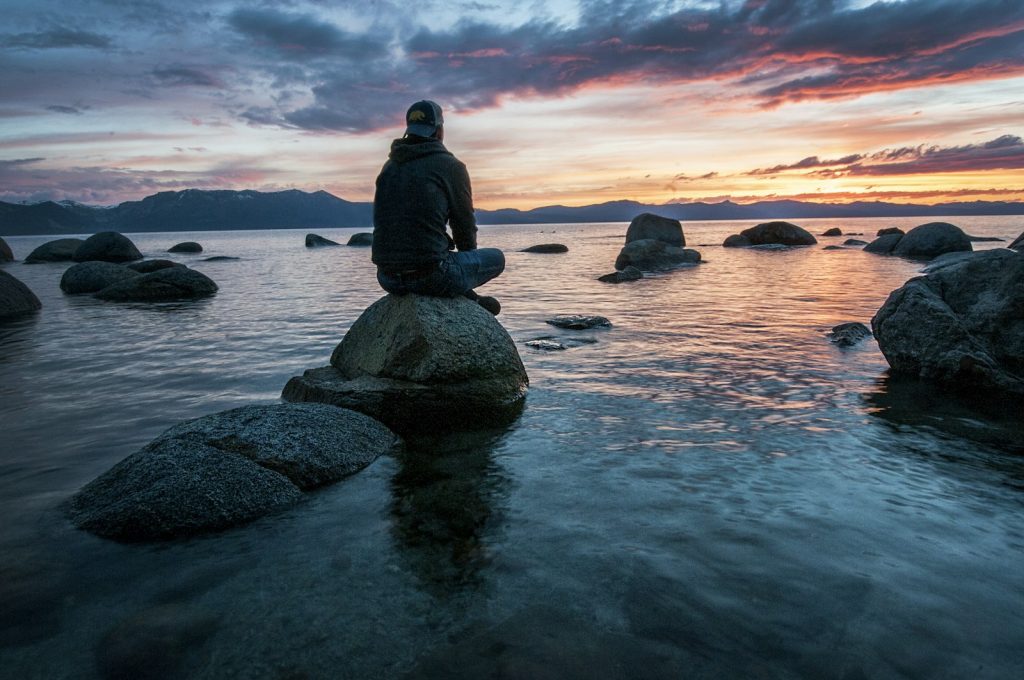
Sitting meditation on a phinisi deck works best in the hour after anchoring, before the crew begins breakfast preparation. The boat settles, ambient noise drops to water and occasional birdcall, and the light is usually extraordinary. Most liveaboard operators will not obstruct this and many quietly appreciate guests who are self-contained at dawn.
Walking practice on Padar, Rinca, or the Komodo Island trekking trails requires a ranger escort — the IDR 200,000 per group (up to five people) trekking fee covers this. The rangers are relaxed with quiet, unhurried groups. A slow, attentive walk is not unusual and draws no comment.
Sound carries differently on open water. If you use audio-guided meditation, headphones preserve the quality for others on a shared boat. If you practice without audio, the sea at anchor in the early morning is as clean an acoustic environment as you will find.
On the wellness dimension: general research consistently associates nature exposure, reduced stimulation, and slower pace with measurable reductions in cortisol and improvements in subjective wellbeing — but these are population-level findings, not guaranteed individual outcomes, and are presented here as general information rather than health or medical advice. Consult a qualified practitioner for personal health decisions.
Cross-Links: Related Wellness Formats
Meditation fits naturally into several broader trip formats we cover on this site. If the yoga dimension is primary for your planning, our Komodo yoga retreat guide covers studio options in Labuan Bajo town (including Bajo Yoga, the region’s longest-running studio, operating since 2017) alongside resort-based classes. If the sailing and nature-immersion element is the draw, our liveaboard wellness guide breaks down the phinisi options in more detail, including how to evaluate a wellness-marketed departure from a standard tour. And if complete disconnection is the goal — phone off, notifications gone, genuine digital absence — the digital detox guide covers which parts of the park still have genuine off-grid conditions and which do not.
Practical Checklist for Planning
- Park entry fee (foreign nationals)
- IDR 250,000 per person per day; diver surcharge IDR 25,000; harbour fee IDR 25,000 — approximately IDR 300,000 total per day for a diver [VERIFY: described as current best information from multiple operator sources; no official government primary document directly cited]
- Booking system
- SiOra (Sistem Informasi Online Reservasi Wisata Alam) — mandatory advance digital booking from 2026; tied to passport number and date; non-transferable
- Lead time
- 2–4 months ahead for peak season (June–September); 4–8 weeks for shoulder season
- Flight to Labuan Bajo
- From Bali (DPS): 1h–1h15m on Indonesia AirAsia, Wings Air, Lion Air, Batik Air, Citilink; from Jakarta (CGK): approximately 2h30m–3h on Garuda, Batik Air, Lion Air, Super Air Jet, Citilink
- Medical considerations
- Malaria risk present in parts of Flores — discuss prophylaxis with a travel medicine clinic; dengue is endemic across Indonesia; nearest recompression chamber may be outside Flores (confirm with dive operator if diving); medical evacuation insurance strongly recommended
- Best months for stillness-focused travel
- April–June and September–November; avoid January–February for rough-sea sensitivity
Frequently Asked Questions
Is there a silent retreat or Vipassana centre in Komodo or Labuan Bajo?
No dedicated silent or Vipassana-style retreat centre with a resident teacher has been confirmed operating in Komodo National Park or Labuan Bajo as of mid-2026. Retreat aggregator listings for the region frequently resolve to Bali-based operators or to pages with zero confirmed local packages. The closest confirmed offering with a contemplative-practice focus in the wider area is Sten Lodge Eco Retreat in Melo village (approximately 30 km from Labuan Bajo), which lists Pranayama, Yoga Nidra, and Meditation — verify directly at +62 813 3722 9724 for current operations.
Which liveaboards actually include meditation in their programmes?
SeaTrek Sailing Adventures markets an eight-day wellness cruise with daily yoga and meditation instruction as a core programme element [VERIFY current departures with the operator]. Samara Liveaboard offers customisable wellness charters with onboard meditation leaders on a private-charter basis [VERIFY content and cost directly]. Aliikai has hosted yoga-and-meditation departures in 2025 through a hosted-retreat model — not every Aliikai sailing includes these sessions. Always confirm directly with the operator whether a specific departure includes meditation or merely offers it optionally, and what the instructor’s background is.
How does the cost of a Komodo meditation retreat compare to Bali?
Bali offers substantially more structured wellness programming per dollar at every tier. A quality seven-day Bali retreat with daily teacher-led practice runs roughly USD 300–800 at mid-range or USD 2,300–2,900 at the luxury end. Comparable Komodo itineraries with wellness sessions cost more — driven by remoteness, logistics, and park fees rather than the quality or depth of the meditation component. The most practical combination for many travellers is a Bali retreat followed by a three-to-four-night Komodo sailing extension as a nature-immersion complement, using the short Bali-to-Labuan Bajo flight connection.
What is the best season for a meditation or mindfulness trip to Komodo?
April to June is the most consistently recommended window: seas are calming after the wet season, temperatures are comfortable, crowds are a fraction of peak, and the landscape has green colour from recent rains. September to November is the second good window, with excellent marine visibility and fewer boats than July–August peak. Both windows offer quiet anchorages and manageable conditions for the Padar sunrise trek, which many visitors describe as one of the most naturally meditative experiences in the region. Avoid January–February if rough-sea conditions or seasickness are a concern.
Can I do my own meditation practice here without joining a formal retreat?
Yes, and for many experienced practitioners this is the better option. The natural environment — quiet anchorages, low humidity, open-sky stargazing, the Padar summit at dawn — provides a quality of sustained attention that structured programmes elsewhere try to recreate artificially. Bring your own practice; the landscape cooperates. On liveaboards, the early-morning hour before breakfast is typically the quietest; on land, resort gardens and private-beach areas give some solitude. The absence of a formal structure is only a limitation if you need one.
Ready to plan a slower, quieter Komodo itinerary? Use our enquiry form or message us on WhatsApp at +62 811 3823 875 — we can help you match the right operator format, season, and pace to what you are actually looking for, with no obligation.