How to read this: Komodo Wellness Retreat is an independent curation guide for wellness travel in the Komodo & Flores region — we compare retreat styles (yoga, meditation, detox, dive-wellness, liveaboard, spa) and then route your enquiry to a vetted partner who handles the booking. We are not a resort, operator, studio or booking platform, and any property or place names are neutral examples only, not claims of affiliation or endorsement. Wellness content here is general information, not medical, health or fitness advice — consult a qualified professional before any detox, fasting, diving or new practice. Park permits, fees, schedules and the ~1,000/day Komodo National Park visitor cap change — confirm current details before you travel. Prices are by quote and vary by retreat, season and group; figures here are indicative ranges only.
A digital nomad in Labuan Bajo is choosing something fundamentally different from the Canggu or Chiang Mai workation circuit. Labuan Bajo is a small port town on the western tip of Flores island in eastern Indonesia — the gateway to Komodo National Park, a UNESCO World Heritage Site — and it is still developing the infrastructure that nomads usually take as baseline: reliable high-speed internet, purpose-built coworking spaces, and a density of coffee shops with power outlets. That gap is not a dealbreaker. But arriving without understanding it leads to frustration, missed deadlines, and an expensive flight home earlier than planned.
This guide is written for the remote worker who already knows they want to work remotely from Labuan Bajo and wants an accurate picture: what the connectivity is actually like, which accommodation formats suit sustained work, how to structure a wellness rhythm around focused productivity, and when to visit to get the balance right. No fabricated coworking directory, no inflated promises about fibre internet that does not yet reach this town.
What Labuan Bajo Actually Offers the Remote Worker
Start with the honest baseline. Labuan Bajo has grown fast — airport passenger numbers reached approximately 1,017,995 in 2024, up from almost nothing a decade earlier, and Marriott opened its first property here in 2024. The town has real restaurants, functional hotels, a paved main strip (Jalan Soekarno-Hatta), and reasonable mobile coverage from the main Indonesian carriers within the town limits. What it does not yet have is the nomad-dense ecosystem of Bali: no Dojo-style coworking hub, no WeWork equivalent, no block-by-block spread of cafes purpose-built for laptop workers.
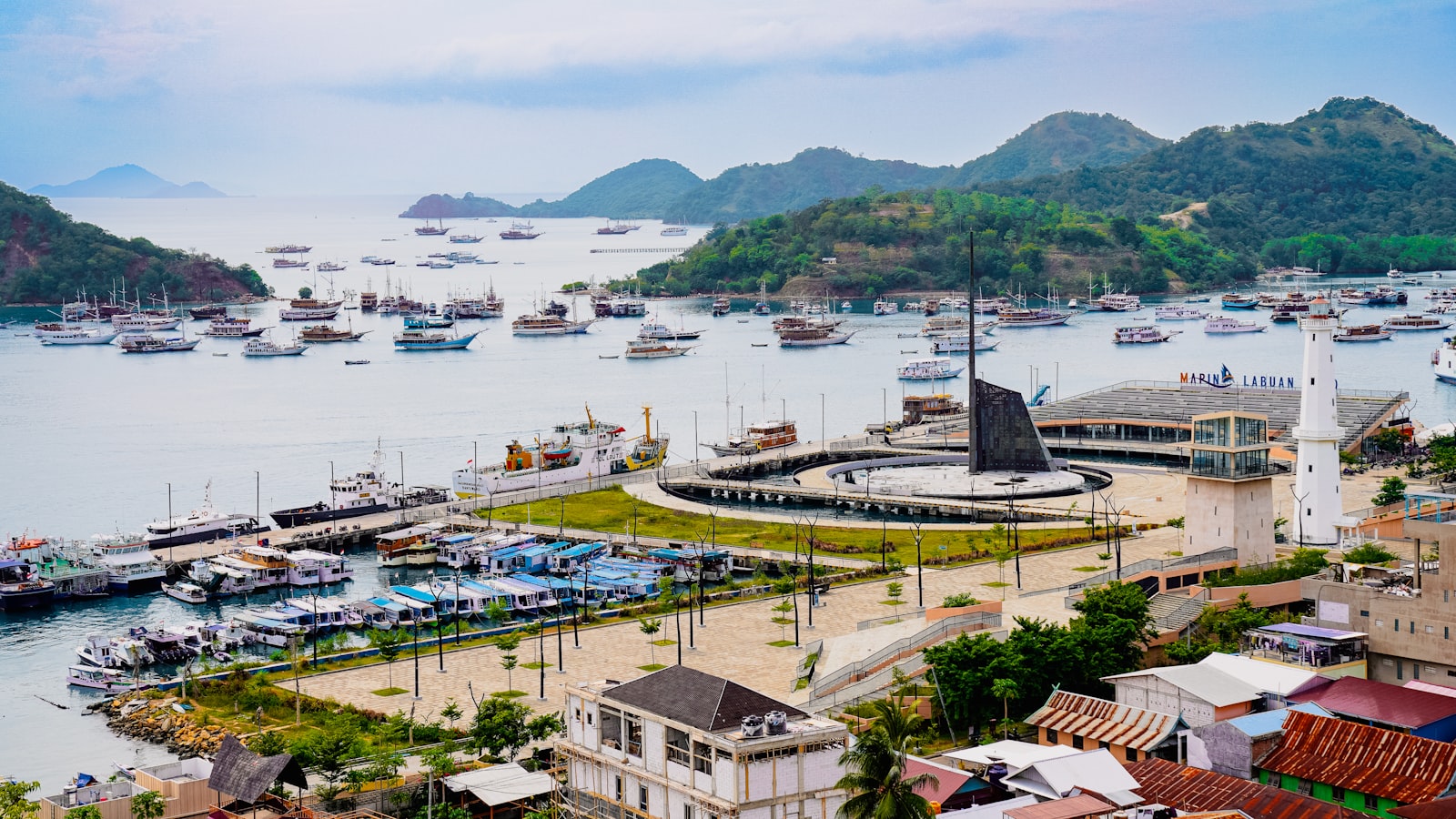
The appeal is real regardless. The town sits at the edge of one of Indonesia’s most extraordinary natural environments. You can finish a morning work block and be snorkelling with manta rays two hours later. The pace is genuinely slower — traffic is light, crowds are manageable outside peak season, and the quality of light across the harbour in the late afternoon has a specific quality that every Bali-fatigued nomad will immediately recognise as something they were missing. The labuan bajo coworking wellness proposition is not about infrastructure density; it is about using a less-saturated natural environment to support a more sustainable working rhythm.
Connectivity Reality: What to Expect and How to Prepare
Indonesian mobile coverage in Labuan Bajo is functional but uneven. The major carriers — Telkomsel, XL Axiata, and Indosat Ooredoo — all have presence here, and Telkomsel’s 4G coverage is the most consistent across the town centre and harbour area. In practice this means connection speeds adequate for video calls and cloud work at most times of day, with slowdowns during evening peak hours and occasional dropped connections during weather events.
Leave town and the picture changes sharply. Inside Komodo National Park — whether on a boat between Rinca and Komodo Island, trekking through the dragon habitat, or anchored at Pink Beach — mobile signal is absent for hours at a stretch. Satellite internet is available on a small number of the larger luxury phinisi liveaboards, usually framed as a premium add-on. On most shared and mid-range boats, connectivity during sailing days is effectively zero. For a remote worker, this means that any multi-day liveaboard trip requires proper planning around deadlines — not an assumption that you can file copy or join a call from deck.
Fibre broadband to accommodation is available in some properties in town but inconsistent. Before booking any villa or guesthouse specifically for a working stay, ask for the actual router speed in writing — ideally a Speedtest screenshot taken at the desk, not at the reception area. A speed of 20–30 Mbps is workable; below 10 Mbps becomes problematic for sustained video calls. Properties positioned in the hills above town often sacrifice connectivity for views.
A local SIM card is the most reliable backup. A Telkomsel Kartu As or HaloData SIM with a monthly data package of 20–50GB runs approximately IDR 100,000–250,000 (~USD 6–16) and is available at the airport arrivals hall or town convenience stores. A 4G mobile hotspot gives you a personal uplink that is not shared with twelve other hotel guests.
Coworking and Working Cafes: What Exists and How to Verify
As of mid-2026, Labuan Bajo has no purpose-built coworking space with the infrastructure that term implies in Bali or Bangkok — reliable high-speed internet, ergonomic seating, meeting rooms, day passes, and a community of other nomads. This situation may change; the town is developing quickly and dedicated coworking is a logical next category. Verify before you book any accommodation on the assumption that a space exists.
What does exist are cafes and hotel lobbies where working is tolerated or welcomed. A cluster of cafes along the main waterfront strip and the road above it — including spots that regularly appear in expat recommendations online [VERIFY names and current status before visiting] — offer Wi-Fi, power outlets, and coffee that is actually good. Flores is genuine coffee country; robusta and arabica from the highlands around Bajawa and Ende reach Labuan Bajo and are roasted and served in the better cafes here. Sit with a local brew, open the laptop, and the basic infrastructure for a morning work session is generally there.
The practical constraints to know:
- Seating ergonomics
- Most cafes here have low rattan chairs or high stools at narrow counters. Five hours at a typical Labuan Bajo cafe table will produce back discomfort that a Canggu coliving space with adjustable chairs would not. Build walking and stretching breaks into any extended work session here — not as optional wellness advice but as a functional requirement.
- Power outlet availability
- More limited than in Bali nomad cafes. Arrive early for the outlets near the wall. A power strip from your bag solves this; bring one from home as they are not reliably available in Labuan Bajo shops at the size and standard you will want.
- Noise environment
- The main strip gets genuinely loud during tour boat departures (early morning, typically 06:00–09:00) and busy lunch periods. Noise-cancelling headphones are not optional kit here. The harbourside energy is part of the appeal — but not during a client call.
- Hours
- Most cafes open around 07:00–08:00 and close by 21:00–22:00. The Indonesian afternoon (13:00–16:00) is often slow; some smaller spots close or reduce service during this window.
Hotel lobbies at mid-range and above properties frequently offer working space to in-house guests. Larger properties with business centres — including some of the Labuan Bajo hotels that market themselves to the conference and government delegation market — may have faster ethernet connections than their guest room Wi-Fi. Ask at check-in. It is not embarrassing to ask; it is exactly the right question.
Accommodation for a Productive Long Stay
The accommodation question for a long stay Labuan Bajo remote worker is where the gap from Bali is most visible. Canggu and Seminyak have villa rental platforms with dedicated home-office setups, fast fibre, and weekly or monthly pricing that works out favourably for stays of 14 days or more. Labuan Bajo has nothing comparable in volume or specialisation.
Three realistic formats:
Hotels on a Long-Stay Rate
Monthly rates at hotels in the USD 50–120 per night bracket (mid-range by Labuan Bajo standards) can often be negotiated to 25–35% below the rack rate for stays of 14 days or longer. This is not guaranteed and is not advertised; it requires a direct conversation with the property manager. Properties in this bracket include a range of boutique hotels and established guesthouses along the main road and the hillside above the harbour. Specific properties should be verified [VERIFY current Wi-Fi speeds and long-stay rate availability] before any commitment. Monthly accommodation cost at this tier: roughly USD 900–2,400 per month depending on property and negotiation.
Private Villa or House Rental
A small number of private homes and villas in the Labuan Bajo area are available for medium-term rental through local agents, Facebook groups, and word of mouth rather than international platforms. Pricing is by quote; expect significant variation based on size, location (hillside with views vs. town centre with convenience), and the landlord’s sense of the market. This format gives you kitchen access, more control over your connectivity setup, and space to work from home-office conditions. The tradeoff is that finding and vetting these properties takes time and local contacts — ideally spend two or three days in town first before committing to a monthly rental.
Resort Stay with Structured Wellness Programming
If the workation concept for you means a deliberate integration of professional productivity with health rituals — morning yoga before the laptop opens, spa treatments in the afternoon, genuine meals — then the resort tier in Labuan Bajo offers a complete package, at a cost. Ta’aktana, a Luxury Collection Resort by Marriott, opened in 2024 and operates the Di’a Spa, a two-storey wellness centre with hot and cold plunge pools and a menu of regional treatments. Rates from approximately USD 490 per night at last known pricing [VERIFY — rates change seasonally]. AYANA Komodo Waecicu Beach and Sudamala Resort Komodo are alternative full-service properties with spa facilities, each at different price points [VERIFY current rates]. These are not designed as coworking environments — they are resort experiences — but a few nights here to reset and work from a well-resourced base is a legitimate workation pattern.
For practical workation guidance and help identifying current long-stay options, reach us via our enquiry form or WhatsApp at +62 811 3823 875. Conditions and availability shift faster than any guide can track.
Building a Workation Wellness Rhythm in Flores
The strongest argument for the remote work and wellness retreat Indonesia proposition in Labuan Bajo is not infrastructure — it is timing. When your office is a laptop and your home base is wherever you choose, placing yourself in a town that gives you direct access to one of the world’s premier marine parks for morning wellness breaks changes the texture of your working day in ways that are difficult to replicate in a city or a resort corridor.
A realistic workation rhythm here looks something like this: early start (06:00–06:30) to align with European or North American time zones during the cooler morning hours, focused work session through to 10:00–11:00, then the morning wellness block — a snorkelling trip to a nearby site, a guided walk in the hills above town, or a yoga class at a local studio or hotel — back for a late lunch, another focused work block in the afternoon, evening at the harbour watching the boats return. This is not aspirational lifestyle content. It is a genuinely achievable daily structure in Labuan Bajo during shoulder season, and it produces a quality of restoration that sitting in a coworking space cannot.
Diving and Snorkelling as the Wellness Anchor
Komodo National Park is among the world’s most biodiverse marine environments, and access to it from Labuan Bajo harbour takes 45 minutes to two hours by speedboat depending on the site. For the nomad who dives or snorkels, this proximity is the defining feature of the location. Day trips to sites within or adjacent to the national park run regularly from the harbour; a half-day snorkelling trip to Kanawa Island or the Pink Beach area is compatible with an afternoon work session. A half-day dive to Tatawa Besar or Siaba Besar, starting at 07:00, has you back in town by midday.
The physical effects of diving and snorkelling on recovery, focus, and stress-state are well-documented in general terms — cold water exposure, breath regulation, sensory immersion, and the particular quality of attention that marine environments demand. None of this requires clinical framing. It just works. Remote workers who build two or three morning water sessions per week into their Labuan Bajo schedule consistently report that it is the most effective productivity intervention they have tried — not because anyone designed it that way, but because it is a forced context switch that no notification can interrupt.
Water temperatures in Komodo average approximately 27–28°C in the north and central zones year-round, dropping to about 23–24°C in the south. The park’s famous strong currents make some sites unsuitable for newer divers — the sites around Batu Bolong, Castle Rock, and the Cauldron specifically carry significant current risk. Beginners have access to sheltered central sites with conservative operators. If you are planning to dive regularly as part of a long stay, a conversation with a local dive centre about your experience level and preferred sites is the right starting point.
Yoga and Movement Options
Structured yoga in Labuan Bajo exists but is limited compared to Bali. Bajo Yoga — described as the first and longest-running yoga service in the town, operating since 2017 — offers community classes for locals, expats, and tourists. Niang Yoga Bajo, an RYT200-certified local instructor with an Instagram presence, offers private and regular group classes. Both warrant direct verification [VERIFY current schedule and contact] before planning your programme around them. Small local operations like these change hours, locations, and availability seasonally and without much online notice.
Some hotel properties offer sunset yoga sessions for in-house guests: Meruorah Komodo Labuan Bajo has an activity programme that includes yoga by the beach [VERIFY current scheduling]. Katamaran Hotel and Resort Komodo runs Soul Bliss Spa with yoga offerings [VERIFY]. Neither of these is a dedicated yoga studio; they are resort amenity programmes, which means availability depends on guest demand and instructor scheduling. Booking ahead is advisable rather than assuming a class will be running on the day you want it.
For a sustained movement practice during a long stay, the most reliable approach is to bring your own: a travel yoga mat, a library of online classes for when the studio is not running, and the habit of using the hills and coastline around Labuan Bajo for walking and movement rather than depending on a scheduled class format. The landscape is extraordinary for this purpose. The loop above the town toward the viewpoints takes 40–60 minutes and involves enough elevation to constitute a meaningful morning movement session.
Recovery and Rest
Traditional Indonesian massage — pijat — is available in Labuan Bajo at a range of price points, from simple in-town massage parlours to the full spa treatment menus at resort properties. Sudamala Resort operates the Sudajiva Spa (563 square metres, three treatment rooms, open daily 09:00–21:00) and runs the most documented multi-day wellness packages in the region, including yoga, Melukat purification ceremonies, and traditional body treatments. Honest note on the Melukat ceremony: it is a Balinese Hindu purification ritual, transplanted to this region’s wellness resort programming. It is a genuine practice, not a fabrication — but it is not indigenous to Flores or the Manggarai culture of western Flores. The Di’a Spa at Ta’aktana offers regional-inspired treatments including lulur body scrubs and warm oil massage. Both properties can be visited as day spa guests independent of overnight stays [VERIFY current day-spa pricing and booking requirements].
For a remote worker spending two weeks or more in Labuan Bajo, one or two spa sessions per week is a reasonable recovery budget to build into your plan. The physical reality of working from non-ergonomic cafe seating, combined with boat trips and dive days, creates a specific pattern of muscle tension — lower back, neck, and shoulders — that responds well to pijat. Think of it as maintenance rather than luxury.
Visa Realities for a Long Stay
This section is not visa advice, and Indonesian immigration rules change without broad public notice. Always verify at the official Indonesian immigration authority website before you travel, and consult a qualified immigration consultant for any stay beyond the straightforward tourist tier.
The framework as of mid-2025 research:
| Visa Type | Duration | Key Conditions | Remote Work Status |
|---|---|---|---|
| Visa on Arrival (VOA) | 30 days, extendable once to 60 days | IDR 500,000 (~USD 35); extend in person at immigration office from May 2025 | Tourist visa — not a work permit. Any paid local work is prohibited. |
| 60-day tourist visa | 60 days | Apply online pre-travel; proof of funds (~USD 2,000), vaccination proof, onward ticket | Tourist visa — not a work permit. |
| e-VOA | 30 days, extendable | Apply online pre-arrival; may not be usable for direct entry at Labuan Bajo — enter via Bali or Jakarta | Tourist visa — not a work permit. |
| KITAS / longer stay | Variable | Separate immigration category; specific conditions and sponsorship requirements apply | Immigration status depends on KITAS type; verify with an immigration specialist |
The short version for the digital nomad: working for clients or employers based outside Indonesia, on a tourist visa, is a grey area that many nomads navigate in practice across Southeast Asia. This guide does not tell you it is legal, because formal Indonesian immigration law does not explicitly authorise it under a tourist visa. Any paid local work — clients, employers, or services rendered within Indonesia — requires appropriate immigration status. For the visa landscape in detail, our logistics and gateway guide covers the current framework and cross-links to official sources. Our visa pages cover the specifics of the Visa on Arrival and its extension procedure.
One practical note: the e-VOA may not be usable for entry directly at Labuan Bajo’s Komodo International Airport (IATA: LBJ). Most nomads arriving from outside Indonesia enter via Bali (Ngurah Rai) or Jakarta (Soekarno-Hatta) and take a domestic connection, which is both the practical and the immigration-correct approach. Flight times from Bali to Labuan Bajo run approximately one hour to one hour fifteen minutes; from Jakarta approximately two hours thirty minutes to three hours.
When to Come: Avoiding the Crowds and Finding the Pocket of Calm
Labuan Bajo’s peak season runs July through August. This is the driest period, the clearest for diving and snorkelling, and the most expensive and most crowded. Hotel rates climb, boat prices follow, and the SiOra booking system for Komodo National Park — which operates on three time slots capping collectively at 1,000 visitors per day across all zones — can sell out weeks in advance for popular trekking dates. For a nomad trying to maintain a productive work routine while managing affordable long-stay costs, July and August are the wrong months.
The best windows for a long stay Labuan Bajo workation from a wellness and productivity standpoint:
- April to June
- Post-wet-season, drying out fast, seas calming on the north and central Komodo side, comfortable temperatures (cooler than the September–November heat peak), green landscapes, and meaningfully fewer tourists than peak. Accommodation rates are negotiable. This is the window most experienced Indonesia nomads and liveaboard veterans cite as the best overall balance.
- September to October
- Excellent marine visibility, fewer boats than July–August, still dry or transitional, and temperatures that can reach 35–37°C midday — which makes an indoor morning work session before an early-morning water activity a sensible structure. Crowds have thinned from peak. A strong second choice.
- November to March (wet season)
- Rougher seas mean liveaboard trips and day boats to the outer park islands are more limited and occasionally cancelled. January and February are the roughest months. A land-based stay in Labuan Bajo town — using the hotel and cafe infrastructure without relying on open-water days — is viable if your wellness anchor is yoga, hillside walking, and in-town spa sessions rather than marine activities. Manta ray aggregations at Manta Alley in the south of the park peak during this window, so dive-focused nomads willing to handle the rougher crossing will find this season genuinely rewarding for that specific experience.
One logistical note on the SiOra permit system that the SERP does not surface clearly: park permits are tied to your passport number and a specific date. They are non-transferable. If your schedule shifts — as nomad schedules often do — you cannot simply move a permit. Book trekking and zone visits with more flexibility in your dates than you think you need, and verify lead times with the operator. In peak season, operators recommend booking two to four months ahead; shoulder season four to eight weeks.
Digital Nomad Labuan Bajo vs. Bali: The Honest Comparison
This question comes up repeatedly and deserves a direct answer.
Bali — specifically Canggu, Seminyak, Sanur, and Ubud — wins on infrastructure by a wide margin at every tier. Faster internet, more coworking options, more structured wellness programming per dollar, deeper restaurant and cafe culture for sustained daily variety, and a longer-established nomad community that makes meeting other remote workers low-effort. If your priority is a smooth, high-bandwidth work environment surrounded by wellness options, Bali is the correct choice.
Labuan Bajo offers something Bali cannot. It is a genuinely small, genuinely remote town at the edge of an extraordinary natural environment that most of the world has not found yet. The park is not metaphorically important — it contains a wild population of approximately 3,270 IUCN-Endangered komodo dragons in their actual habitat, UNESCO World Heritage recognition since 1991, and some of the strongest and most biodiverse diving currents in the world. You cannot manufacture proximity to that in Canggu.
The nomad pattern that works best: Bali for sustained productive stretches (two to four weeks of high-output work from a well-resourced coworking or villa setup), then Labuan Bajo for a deliberate reset and natural wellness immersion (one to three weeks, structured around the workation rhythm described above). Labuan Bajo is one hour by flight from Bali’s Ngurah Rai Airport, with Citilink, Lion Air, Batik Air, Indonesia AirAsia, and Wings Air all operating the route. The connection is fast and affordable enough to treat the two locations as complementary parts of a single Indonesian long-stay rather than a binary choice.
Health and Safety Baselines
A long stay anywhere in eastern Indonesia requires a baseline of health preparation. This is not alarmist; it is what the region’s actual health infrastructure makes sensible.
Medical facilities in Labuan Bajo centre on RSUD Komodo, the district public hospital — adequate for routine care and basic emergencies, not equipped for major trauma, cardiac events, or complex surgical care. Those require evacuation to Bali or Jakarta. Comprehensive travel insurance with medical evacuation cover is not optional for a long stay here. Dive insurance — specifically covering decompression illness and hyperbaric chamber treatment — is mandatory if you plan to dive. Verify the location of the nearest functional recompression chamber with your dive operator before booking; it may not be on Flores.
Vaccinations to discuss with a travel medicine clinic six to eight weeks before departure: Hepatitis A, Hepatitis B, Typhoid, and Rabies if you plan rural or animal-contact activities. Malaria risk is present in parts of Flores — discuss prophylaxis with a travel medicine doctor rather than making your own assessment. Dengue is common across Indonesia; mosquito precautions (long sleeves at dusk, repellent with DEET or Picaridin, accommodation with effective screening) are the practical mitigation.
Planning Your Labuan Bajo Workation: The Practical Summary
The digital nomad Labuan Bajo proposition is real, but it requires honest expectations going in. Connectivity is functional within town limits and unreliable outside them. There are no dedicated coworking spaces yet. Long-stay villa rental requires local legwork rather than a platform booking. The wellness infrastructure is thinner than Bali in structured programming but richer in natural opportunity — daily access to one of the world’s premier marine environments, genuine quiet, a pace of life that is slow by default rather than by effort.
The workation rhythm that works here is a morning-first structure: deep work before the heat peaks and before the tourist activity generates noise, then outdoor wellness (water, hills, movement) in the late morning, a quieter afternoon work block, and evenings at the harbour. Build your park visits, liveaboard trips, and dive days around your deadlines rather than assuming connectivity will bridge the gap. When you are at sea inside Komodo National Park, you are offline. Plan accordingly, and that constraint becomes an asset.
No operator or property can pay to change what we write. If you use our free planning support and proceed with an accommodation, operator, or wellness programme we recommend, they may pay us a referral fee at no extra cost to you. Our job is accuracy, not promotion.
To plan your workation — whether you want help identifying current long-stay accommodation, understanding the SiOra permit booking system, or building a programme around your specific work schedule — use our enquiry form or message our concierge directly on WhatsApp at +62 811 3823 875 or by email at sales@komodoluxury.com. We can help you build a realistic schedule that makes the most of what this particular corner of Indonesia does well.
Frequently Asked Questions
Is the internet in Labuan Bajo fast enough for remote work?
Within Labuan Bajo town, 4G mobile coverage from Telkomsel is the most reliable option and is generally adequate for video calls and cloud-based work during off-peak hours. Hotel and villa broadband speeds vary significantly — ask for a current Speedtest result at the desk before booking for a working stay, and verify rather than assume. Outside town, particularly inside Komodo National Park and on the water between islands, connectivity drops to minimal or zero for extended periods. Carry a local Telkomsel SIM with a data package as your primary uplink. It is not a Bali-grade setup, but it is workable with the right expectations and preparation.
Are there coworking spaces in Labuan Bajo?
As of mid-2026, no purpose-built coworking space with the infrastructure that term typically implies — guaranteed fast internet, ergonomic seating, day passes, meeting rooms — has been confirmed operating in Labuan Bajo. Working from cafes along the main strip is the practical alternative; a cluster of spots near the harbour offer Wi-Fi, power outlets, and good local coffee. Arrive early for the best seating and outlet access. The situation may change as the town develops; verify before any trip planned around a specific coworking facility.
What visa do I need to work remotely from Labuan Bajo?
The Visa on Arrival (IDR 500,000, 30 days extendable once to 60 days total) is the standard entry for most Western travellers to Indonesia. It is a tourist visa, not a remote work permit. Working for clients or employers based outside Indonesia on a tourist visa is a grey area in Indonesian immigration law that many nomads navigate informally across Southeast Asia. Any paid work involving Indonesian clients or Indonesian employment requires appropriate immigration status. A 60-day tourist visa is available for pre-travel online application. Extensions must be done in person at an Indonesian immigration office since the May 2025 rule change. Always verify current requirements at the official Indonesian immigration authority and consult a licensed immigration advisor for any complex or extended stay. Our logistics page covers the visa framework in more detail.
What is the best time of year for a workation in Labuan Bajo?
April through June is widely considered the strongest window: seas calm down from the wet season, temperatures are comfortable, tourist numbers are well below peak, and accommodation rates are negotiable. September and October offer a strong second window with excellent marine conditions and fewer crowds than the July–August peak. July and August are the driest and most scenic months but the most crowded and most expensive — park permits and accommodation book up weeks in advance, which conflicts with the flexibility a nomad schedule usually requires. The wet season (November to March) is viable for a town-based stay but limits open-water marine activity.
Can I combine a workation in Labuan Bajo with a liveaboard sailing trip?
Yes, but plan the sailing days as deliberate offline time rather than assuming connectivity. Standard phinisi liveaboards in the national park run two nights and three days, typically without satellite internet. Wellness and yoga liveaboard programmes — from operators like SeaTrek Sailing Adventures, Samara Liveaboard, and hosted departures like the Wander Women Dive and Yoga trips on Aliikai — add structured programming on top of the sailing experience but do not change the connectivity situation. Build your liveaboard days around a gap in your deadline schedule, not around an assumption you can work from a boat. Treat those days as the active recovery component of your workation — offline, in the water, in the national park — and they become the best part of the trip.