How to read this: Komodo Wellness Retreat is an independent curation guide for wellness travel in the Komodo & Flores region — we compare retreat styles (yoga, meditation, detox, dive-wellness, liveaboard, spa) and then route your enquiry to a vetted partner who handles the booking. We are not a resort, operator, studio or booking platform, and any property or place names are neutral examples only, not claims of affiliation or endorsement. Wellness content here is general information, not medical, health or fitness advice — consult a qualified professional before any detox, fasting, diving or new practice. Park permits, fees, schedules and the ~1,000/day Komodo National Park visitor cap change — confirm current details before you travel. Prices are by quote and vary by retreat, season and group; figures here are indicative ranges only.
Coral reef blue mind wellness in Komodo describes the measurable calming effect of immersion in — or proximity to — a living reef ecosystem within Komodo National Park. The term draws on marine biologist Wallace J. Nichols’ “blue mind” thesis: that water environments trigger a mildly meditative neurological state, lowering cortisol, slowing heart rate, and shifting the default-mode network toward quieter, more receptive thinking. In Komodo, this effect arrives with extra texture. You are not simply near water; you are floating above one of the most biologically complex reef systems on the planet, watching an ecosystem carry out ten thousand simultaneous negotiations between species. That specificity matters for the quality of the mental state it induces.
This guide explores what the science actually supports, what Komodo’s reefs honestly offer right now, and how to practise mindful snorkelling in a way that serves both your own recovery and the reef’s long-term survival. No fabricated dive-site ratings. No invented coral-cover percentages. Just a clear-eyed look at one of the most affecting ocean experiences available in Southeast Asia.
What “Blue Mind” Actually Means
Nichols’ framework, popularised in his 2014 book of the same name, synthesises neuroscience research on how aquatic environments affect the brain. The evidence base covers fMRI studies of coastal residents, self-reported mood tracking in beach versus urban settings, and clinical applications in water-based therapy. The consistent finding: water proximity — even a fountain, even a recording of rain — nudges the autonomic nervous system toward parasympathetic dominance. Pulse slows. Breath deepens without effort. The mind’s inner monologue softens.
A living coral reef adds a dimension that a swimming pool cannot replicate. Colour, movement, scale, and biological unpredictability all contribute to what cognitive scientists call “soft fascination” — a state of effortless attention that allows the directed-attention system to rest and recover. The reef does not demand focus the way a spreadsheet or a traffic queue does. It rewards attention without requiring it. That distinction is central to why snorkelling above healthy coral functions more like meditation than like sightseeing.
One important caveat: blue mind therapy as such is not a licensed clinical intervention. If you carry a diagnosed anxiety disorder, a mood condition, or PTSD, the ocean may complement professional treatment — it does not substitute for it. We note this because honest wellness writing requires it, not to dampen the experience. The restorative effects are real and well-documented; their application is general rather than medical.
Komodo’s Marine Environment: The Honest Picture
Komodo National Park holds UNESCO World Heritage status, inscribed in 1991 partly for its marine and coral reef biodiversity. The park spans the convergence of warm Flores Sea water from the north and cooler, nutrient-rich upwelling from the south — a thermal gradient that supports exceptional species density. Reef fish diversity across Komodo is among the highest recorded anywhere in the Indo-Pacific.
That is the case for coming. Now the candour.
The IUCN World Heritage Outlook currently rates the park’s conservation status as “significant concern.” That assessment reflects cumulative pressure on natural values across the site, including marine systems. No current peer-reviewed figure for live coral cover or bleaching extent in Komodo is available in published sources as of mid-2026. Anyone who quotes you a specific percentage for current reef health is either working from private survey data or extrapolating. We will not do either.
What we can say with confidence: the reefs remain intact enough to support the exceptional fish biomass and megafauna — manta rays, reef sharks, green and hawksbill turtles, Napoleon wrasse — that define the Komodo experience. Bleaching events have affected reefs across the Indo-Pacific in recent years, and Komodo is not exempt from those pressures. Visitor density, anchor damage, and runoff from Labuan Bajo’s rapid development all carry measurable consequences. Visiting with care is not optional etiquette; it is material to whether the reef survives at the quality level that makes blue-mind snorkelling possible at all.
This is not a reason to avoid Komodo. It is a reason to visit in a way that acknowledges the reef as a finite resource that outlasts any single trip.
Ocean Healing in Komodo: Sites Worth Knowing
For ocean healing on Komodo reef, the calmer, shallower sites tend to deliver the strongest blue-mind conditions — deep parasympathetic engagement requires the absence of anxiety, and anxiety is hard to avoid when you are being swept through a channel at “whitewater-rafting” speeds. Save the adrenaline dives for the days when you want stimulation. For restoration, pick accordingly.
Pink Beach (Pantai Merah)
The reef fringing Pink Beach on Komodo Island is accessible directly from shore, requiring no boat transfer once you are on the island. The shallow slope — between two and eight metres over the first hundred metres from the beach — supports hard coral gardens and reasonable fish diversity. Current is generally mild inshore. The rose-tinted sand, coloured by fragments of Foraminifera shells mixed with white coral sand, provides an unusual visual anchor that reinforces the meditative quality of the entry. This is the site most suited to absolute beginners and to travellers whose primary goal is calm immersion rather than species-list ticking.
Siaba Besar
A gentler drift site in the central park zone, Siaba Besar is well-regarded for green sea turtle sightings. Turtles are among the most effective blue-mind catalysts the ocean offers — their unhurried movement and apparent indifference to observers tends to anchor the snorkeller’s attention completely, producing what psychologists describe as a state of absorbed presence. Visibility here typically runs 15–30 metres in the dry season (April–October), and currents, while present, are gentler than the park’s headline sites.
Manta Point (Makassar Reef)
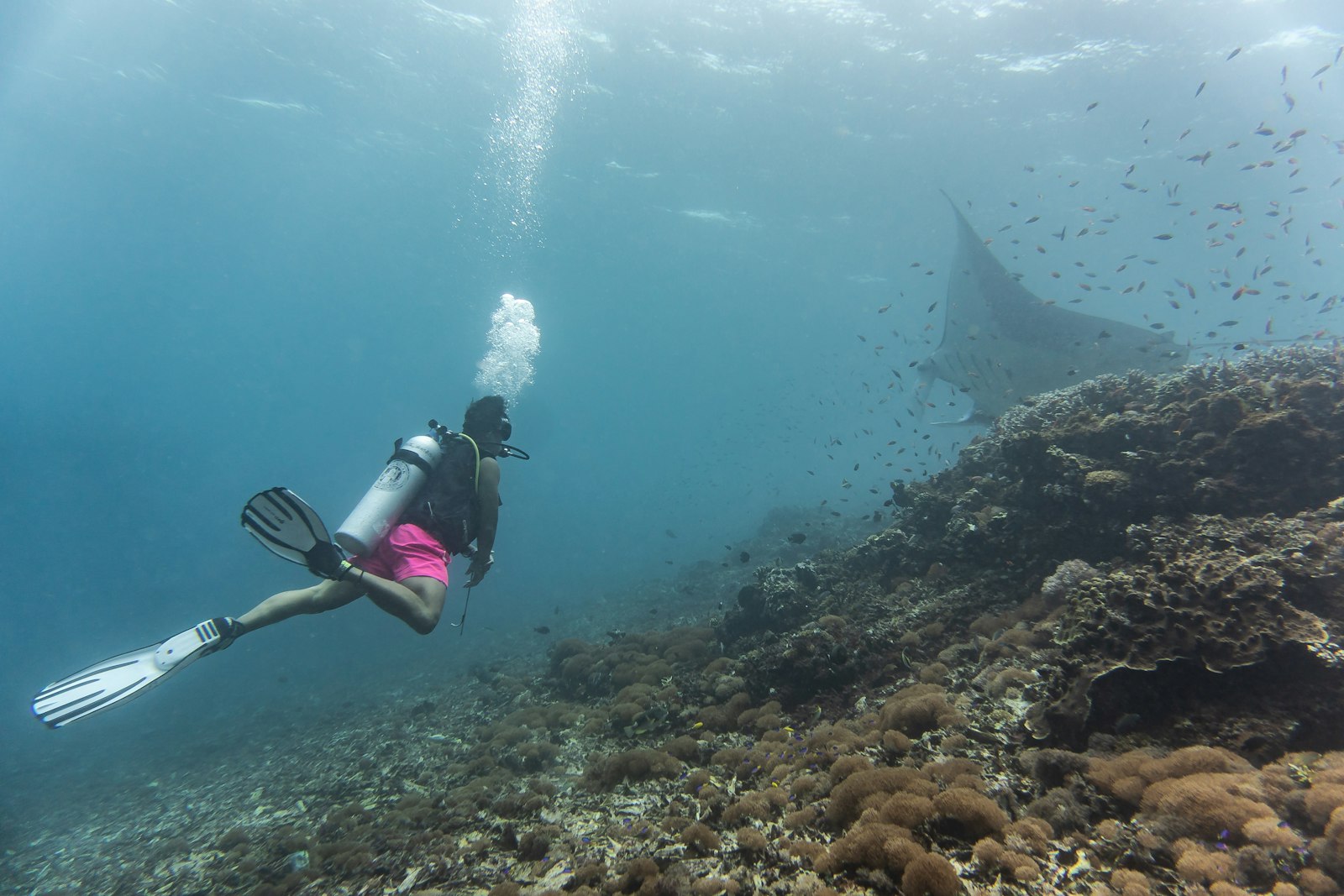
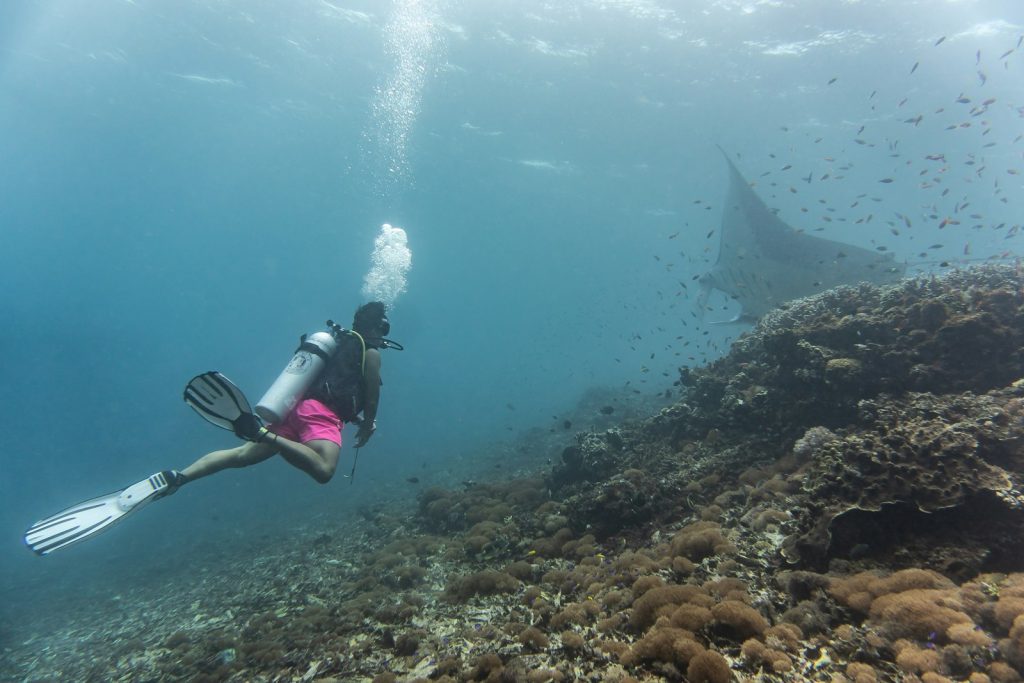
We cover the manta experience in more depth in our manta snorkel wellbeing guide, but Manta Point deserves mention here because ocean healing and manta encounters intersect in ways that seem outsized. The reef at Makassar is relatively shallow, and the mantas — resident oceanic manta rays (Mobula birostris) — circle the cleaning station at close range, often within two or three metres of patient, still snorkellers. The encounter is cognitively overwhelming in a useful way: the brain cannot maintain its normal background noise when something four metres across is banking silently overhead. The peak window for resident mantas at Manta Point is November through April.
Kanawa Island
Technically outside the national park boundary but operationally grouped with Komodo trips by most operators, Kanawa offers house reef snorkelling from the island’s small jetty. The reef here is accessible at any tide, which matters for blue-mind practice: spontaneous, unscheduled sessions in the water — fifteen minutes before breakfast, or half an hour at dusk — are where the restorative effect compounds most naturally. A single guided snorkel excursion is a highlight; a week of daily reef contact is a wellness practice.
Blue Mind Therapy in Komodo: Practising Mindfully
Blue mind therapy in Komodo does not require any formal instruction, but a few deliberate choices deepen the effect and protect the environment simultaneously.
Breath as the entry point
Before entering the water, take three slow breaths — four counts in, six counts out. This is not ceremony; it is physiology. Slow exhalation activates the vagus nerve and initiates the parasympathetic shift you are trying to sustain underwater. Once in the water, your natural snorkel breath is already closer to this rhythm than normal speaking-world breathing. The reef rewards you for noticing that.
The “two-metre rule” as mindfulness anchor
A practical reef-safe rule — maintain two metres from any coral structure — doubles as a mindfulness prompt. Every time you notice you are drifting closer, you are practising present-moment awareness. The reef does not care about your mental state, but your mental state benefits from caring about the reef. The convergence is not incidental.
Stillness over distance
Covering the maximum number of sites in the minimum time is the tourist mode. The blue-mind mode is opposite: find a coral head you find compelling, hover above it without moving, and spend ten minutes doing nothing except watching. Most snorkellers never do this. Those who try it reliably report that it is the most memorable ten minutes of their trip.
Reef-Safe Snorkelling: Ethics and Practice
Reef snorkel wellbeing in Komodo only makes sense in the context of a reef that persists. The ethical requirements are not complicated, but they are non-negotiable.
- Sunscreen
- Use only mineral sunscreens with non-nano zinc oxide or non-nano titanium dioxide as the active ingredient. Chemical UV filters — oxybenzone, octinoxate, and related compounds — are documented coral bleaching agents at concentrations found near popular snorkel sites. Reef-safe mineral options are now widely available; there is no practical case for the alternative.
- No touching
- Contact with coral — even a fingertip brush — can remove the protective mucus layer that the coral polyp secretes. This leaves the polyp vulnerable to infection and thermal stress. Even coral that appears dead may be in a recovery phase. Keep hands to yourself, including on rock substrates where cryptic benthic species are invisible without close inspection.
- Buoyancy and fin control
- The most common source of incidental reef damage from snorkellers is fin kick. Backwards fin kicks in shallower water stir sediment that smothers coral and, on contact, can break branching species. Learn to swim horizontally and to control your position without sculling with your hands near the bottom. If you are uncertain, choose a calm site and practise in open water first. This skill also improves your own experience — you move more quietly, and fish approach rather than flee.
- Mooring buoys
- Where mooring buoys are available, operators are required to use them. Anchor drops on coral structures are prohibited within the park. If your operator drops anchor on reef, it is worth raising quietly — most are unaware rather than indifferent.
- Marine debris
- Labuan Bajo sits at the edge of one of Asia’s most plastic-polluted sea corridors. Bringing a mesh bag and collecting surface plastic during snorkel sessions is a small act with a disproportionate psychological effect: the reef becomes something you are tending, not merely consuming. Reciprocity changes the emotional register of the whole experience.
Planning the reef-safe approach to your trip is also where our enquiry form or a WhatsApp conversation can help — we can suggest which operators prioritise reef-first practices and which sites are best suited to your snorkelling experience level.
When to Come for Reef Snorkel Wellbeing
Timing affects the quality of the blue-mind experience significantly. The table below summarises the key variables.
| Period | Sea Conditions | Water Temp (avg) | Visibility | Crowds | Blue-Mind Rating |
|---|---|---|---|---|---|
| April–June | Calm to light chop; drying-out phase | 28–29°C | Good (15–30m north/central) | Low–moderate | Excellent — calm water, fewer boats, comfortable temperature |
| July–August | SE monsoon; larger waves on south coasts; calmer north | 26.5–28°C | Best of year (north) | Peak crowds | Good for visibility; crowds reduce solitude quality at busy sites |
| September–November | Settling; excellent calm windows | 27–29°C | Very good | Moderate, declining | Very good — post-peak lull, strong conditions, fewer boats |
| December–March | NW monsoon; rougher seas; squalls possible Jan–Feb | 29–29.5°C | Reduced (plankton bloom) | Low | Variable — manta season is excellent for Manta Alley; general snorkel sites can be rough |
April through June is the window we most consistently recommend for travellers whose primary goal is slow, restorative reef contact. The seas have calmed from the wet-season swells, the light is generous, water temperature sits in the 28–29°C range — warm enough to spend an hour in the water comfortably without a wetsuit, cool enough not to be soporific. Crowds are below peak. The reefs are not yet under the full pressure of the July–August surge.
Park Access: What You Need to Know Before Booking
Komodo National Park introduced a daily visitor cap in early 2026 — a trial system of approximately 1,000 visitors per day across all zones, divided across three time slots (06:00–11:00 / 11:00–15:00 / 15:00–18:00) via the SiOra digital booking platform. This is described officially as a pilot, not permanent policy, but operators are applying it as the operative system. All permits are tied to your passport number and a specific calendar date; they are non-transferable.
The cost structure as of 2025–2026 (multi-operator sourced; no official primary government document cited):
- Park entry fee (foreign nationals): IDR 250,000 per person per day
- Diver surcharge (for those also diving): IDR 25,000 per diver per day
- Harbour fee: IDR 25,000 per person per day
- Total typical daily cost for a foreign snorkeller: approximately IDR 275,000
Operators recommend booking permits two to four months ahead in peak season (June–September) and four to eight weeks ahead in shoulder periods. Walk-up permits are no longer available. The park fee does not include boat transport, meals, or guide fees — these are arranged separately through your operator.
For divers, our dive wellness retreat guide covers the full breakdown of dive-specific permits, nitrogen-safe scheduling, and the growing number of liveaboards integrating recovery practices between dives.
The UNESCO Context: Why Conservation Adds Meaning
There is a dimension to reef snorkel wellbeing in Komodo that most wellness writing ignores: visiting a site under conservation pressure while knowing its status shifts the experience from passive recreation toward something more deliberate. The IUCN’s “significant concern” rating for Komodo National Park is not alarming in the sense of imminent collapse, but it is a factual reminder that the reef’s current condition is not guaranteed.
That knowledge changes how you float above a coral head. It converts tourism into witness. Psychologists who study the intersection of nature exposure and meaning-making note that conservation context — understanding that what you are experiencing is finite and maintained by deliberate effort — intensifies the emotional imprint of the encounter. The blue-mind effect is deeper when it carries moral weight.
Our UNESCO World Heritage guide covers the park’s conservation history, the 2021 UNESCO review process, and what travellers can do to support responsible tourism in a site of genuine global significance.
If you want to plan a visit that accounts for all of this — timing, reef-safe operator selection, permit logistics, and the right sites for your experience level — plan your trip with our team, or reach us directly on WhatsApp at +62 811 382 3875 ([email protected]). We know the operators who prioritise reef stewardship, and we can help you build an itinerary that holds both the wellbeing goal and the conservation ethic together.
Frequently Asked Questions
Is blue mind therapy in Komodo suitable for non-swimmers?
Blue mind benefits from reef proximity do not require swimming competence. Sitting at the water’s edge on Pink Beach, watching the marine activity in the shallows from a kayak, or snorkelling in very shallow water with a life jacket are all valid entry points. The parasympathetic shift that blue mind describes begins with visual contact with water, not just immersion. That said, non-swimmers miss the close-range reef contact that amplifies the effect most strongly — a guided shallow-water snorkel lesson with a patient operator can open that dimension safely.
What is the best reef snorkel site for a first-timer focused on wellbeing rather than marine life lists?
Pink Beach and Siaba Besar are the two sites most consistently suited to slow, restorative snorkelling without demanding strong swimming technique or comfort with current. Siaba Besar’s turtle population makes sustained, quiet hovering natural — you wait, the turtles come, the mind settles into the rhythm of the encounter. Pink Beach works better for independent, unguided exploration because its shoreline entry removes the anxiety of boat-to-water entry, which disrupts the calm state you are trying to reach before you are even in the water.
Does the water temperature affect the ocean healing experience in Komodo?
Yes, meaningfully. Komodo’s water temperature ranges from approximately 26.5°C at its coolest (August, especially south Komodo, where upwelling can push it to 23–24°C) to 29.5°C in the warm season. The blue-mind response is most accessible in water between 27°C and 29°C — warm enough that the body does not divert cognitive resources toward thermoregulation, cool enough to feel refreshing rather than inert. August snorkelling in south Komodo can feel genuinely cold without a 3mm wetsuit. April through June in the central and north park hits the sweet spot for most visitors.
Are reef-safe sunscreens easy to find in Labuan Bajo?
The honest answer is: sometimes, in limited selections. The town’s dive shops and a few pharmacies stock mineral options, but not reliably. Bring your own from home or from Bali, where the selection is substantially better. Flying from Bali to Labuan Bajo takes approximately one hour — it is the most common approach route and gives you access to Bali’s well-stocked organic and dive-supply shops before the more remote leg of the trip.
Can I combine reef snorkelling with a spa treatment on the same day — or is that counterproductive for wellbeing?
Physiologically, the two complement each other well when sequenced correctly: snorkel in the morning when visibility is clearest and your energy is high, then schedule a spa treatment in the afternoon when the parasympathetic state from the reef is already primed. The massage deepens rather than interrupts the relaxation arc. What works less well is reversing the order — entering cold water within two hours of a warming deep-tissue treatment can cause nausea and undo the benefits of both. Morning reef, afternoon spa: the classic pairing for a reason.