How to read this: Komodo Wellness Retreat is an independent curation guide for wellness travel in the Komodo & Flores region — we compare retreat styles (yoga, meditation, detox, dive-wellness, liveaboard, spa) and then route your enquiry to a vetted partner who handles the booking. We are not a resort, operator, studio or booking platform, and any property or place names are neutral examples only, not claims of affiliation or endorsement. Wellness content here is general information, not medical, health or fitness advice — consult a qualified professional before any detox, fasting, diving or new practice. Park permits, fees, schedules and the ~1,000/day Komodo National Park visitor cap change — confirm current details before you travel. Prices are by quote and vary by retreat, season and group; figures here are indicative ranges only.
Breathwork for divers in Komodo refers to the deliberate use of breathing techniques — drawn from yoga pranayama, mindfulness, and sometimes specialised freediving methodology — to support calmer, more efficient underwater performance in one of the world’s most current-driven marine environments. In practical terms this means slower, fuller breath cycles that lower resting heart rate before entry, controlled exhalation patterns that reduce air consumption during a dive, and the kind of settled nervous system that does not spiral into shallow breathing the moment a wall of current hits at Batu Bolong. It is not a replacement for proper dive training, and the more advanced end of breath-hold practice carries real physiological risk. But as a general wellbeing support for recreational and technical divers, the case for integrating some form of breathwork and yoga into a Komodo trip is straightforward — and almost nobody talks about it in practical terms.
This guide covers what is useful, what requires professional guidance, and what to be genuinely cautious about.
Why Komodo Divers in Particular Benefit
Komodo National Park’s dive sites are famous for two things: exceptional biodiversity and relentless current. The Flores Sea, the Sape Strait, and the channels running between Komodo and Rinca islands funnel enormous tidal volumes through relatively narrow passages. Sites like The Cauldron (sometimes called Shotgun) and the northern seamounts of Castle Rock and Crystal Rock are described in operator briefings as approaching whitewater-rafting intensity on certain tide windows. Even the more accessible central sites — Tatawa Besar, Siaba Besar, the Pink Beach corridor — see regular strong drift conditions.
Strong current does something specific to diver physiology that gentle reef diving does not. When you hit an unexpected surge or need to hold position against a lateral push, the natural response is a stress cascade: muscle tension increases, breath rate climbs, and air consumption spikes. For a diver already running on adrenaline from the pre-dive briefing about the site’s reputation, the effect compounds. Experienced guides here frequently observe that the divers who consume their tank fastest are often not the least fit — they are the most anxious.
That is where a grounded breath practice becomes practically useful. Not as a performance-enhancement protocol, but as a tool for managing the physiological state that dictates whether your 200-bar tank lasts 40 minutes or 25.
Gentle Pranayama: What Works Before a Dive
Pranayama — the yogic science of breath regulation — offers several techniques that transfer well to the pre-dive context. Three are particularly practical for Komodo diving conditions, and all three can be practised on the phinisi deck or in a resort garden without any special equipment.
Nadi Shodhana (Alternate Nostril Breathing)
This technique involves alternating the breath through left and right nostrils using the thumb and ring finger. The mechanism is a slow, controlled cycle: inhale left, close both, exhale right, inhale right, close both, exhale left. A typical pre-dive session of five to eight minutes at a comfortable pace — not forced — has a measurable settling effect on heart rate variability. The research behind exactly why is still being refined, but the subjective experience for divers is consistent: the mental chatter about the site conditions quiets. You board the dive tender in a different state than if you spent those five minutes reviewing the briefing over and over.
This is general wellbeing information. How your body responds is individual, and anyone with a respiratory condition, cardiovascular concern, or active ENT issue should consult their doctor before adding new breathing practices to their routine.
Extended Exhalation Breathing
This one is simpler and requires no hand position or technique: inhale for a count of four, exhale for a count of six to eight. The extended exhale activates the parasympathetic nervous system more directly than an equal-ratio breath. For divers, there is a useful corollary here: underwater breath control is largely an exhale skill anyway. Scuba diving teaches you to breathe continuously (never hold your breath on scuba — that is non-negotiable for lung injury prevention), but it does not specifically train you to slow your exhale, which is where most air consumption inefficiency lives. Extended exhalation breathwork on the surface trains the same muscle memory that efficient underwater breathing uses.
Box Breathing (Sama Vritti)
Equal-count breathing — four counts inhale, four hold, four exhale, four hold — is used widely in high-stress professional contexts including military applications. For divers, the hold phases are genuinely educational: they reveal how much tension you carry in the breath cycle, and they are a reminder that your lungs have more capacity than you typically use in shallow everyday breathing. Box breathing is best introduced on land at a comfortable count — four seconds per side is a reasonable start — and built gradually. It is not appropriate as a pre-dive breath-hold drill on its own; the breath-hold component in a proper context is educational, not preparatory for underwater use.
Yoga for Scuba Divers Komodo: The Mobility Angle
The physical demands of diving are underrated from a musculoskeletal perspective. A typical day in Komodo involves three or four dives, each requiring: climbing in and out of a dinghy in kit that adds 15–20 kilograms of total weight, equalising pressure repeatedly through descent, maintaining a horizontal trim position that loads the lower back and hip flexors, and carrying gear to and from the water. Over three or four consecutive dive days, most divers accumulate tightness in predictable patterns: hip flexors, thoracic spine, neck, and shoulder girdle.
Yoga for scuba divers in Komodo is not about achieving complex postures. The useful practice is much more specific.
Hip Flexor Opening for Trim Position
Divers who spend most of their time in forward-compressed positions — seated on a boat bench, hunched over their BCD setup, or driving a desk back home — often have shortened hip flexors that tilt the pelvis forward in the water. This creates the classic new-diver position: legs dropping, finning inefficiently, burning through air faster. Low-lunge (Anjaneyasana) and half-pigeon variations held for 60–90 seconds per side address exactly this pattern. You do not need a mat; a folded towel on a dry deck section works fine.
Thoracic Rotation for Equalisation Comfort
Many divers restrict their equalisation attempts by unconsciously locking the upper back and neck. Seated thoracic twists — sitting cross-legged or in a chair and rotating gently to place the opposite hand on the knee — open the mid-spine and relieve the compensatory neck tension that comes from looking up while descending. Thread-the-needle, done prone, is another effective option that requires no standing balance and is manageable on even a slightly rolling phinisi deck.
Shoulder and Chest Opening
Pulling on wetsuits, carrying tanks, and constant gear adjustment creates chronic tightness across the anterior chest and internal shoulder rotators. Supported fish pose with a rolled towel or life jacket under the thoracic spine is the gentlest option. A simple doorway chest stretch — hands on a frame, lean forward — works if there is no deck space. These are five-minute interventions, not yoga sessions; that is the point. Diver lung capacity yoga does not require an hour-long practice to be worth doing.
Mindful Pre-Dive Grounding: The Five Minutes That Change the Dive
There is a specific moment on every Komodo liveaboard that experienced guides recognise: the transition from boat to water at a challenging site. Divers are checking equipment, adjusting masks, listening to last-minute briefing reminders about the current direction, and processing a visible landscape that communicates something along the lines of: this is serious. Heart rate is up. Some divers are already breathing shallower than they will on the reef.
A brief grounding practice in this window — two to three minutes, not a ceremony — makes a measurable difference for many people. The elements are simple:
- Sit or stand with feet planted. Feel the contact between feet and deck.
- Take three long, slow breaths with extended exhale. Do this before putting on the mask.
- Bring attention briefly to what you can see, hear, and feel — the specific sensory details of this anchorage, this dive site, this water temperature. This is not woo; it is a basic attentional focus technique that interrupts the rumination loop about what might go wrong.
- Review the briefing points once, clearly and deliberately, rather than cycling through them anxiously.
This is mindfulness applied practically, not philosophically. The goal is to enter the water in a settled state rather than an aroused one. Every experienced dive guide in the park will tell you that the divers who stay calm at depth, read the current well, and use their air efficiently share one observable characteristic: they are not fighting their own nervous system.
If you want support building this kind of pre-dive practice into a Komodo trip, our concierge team can connect you with liveaboard operators and land-based retreats who integrate structured breathwork alongside diving. Message us on WhatsApp at +62 811 3823 875.
Breathing Exercises for Freediving in Komodo: A Serious Caution
Freediving — breath-hold diving without scuba equipment — sits at a different point on the risk spectrum, and it is important to be direct about this.
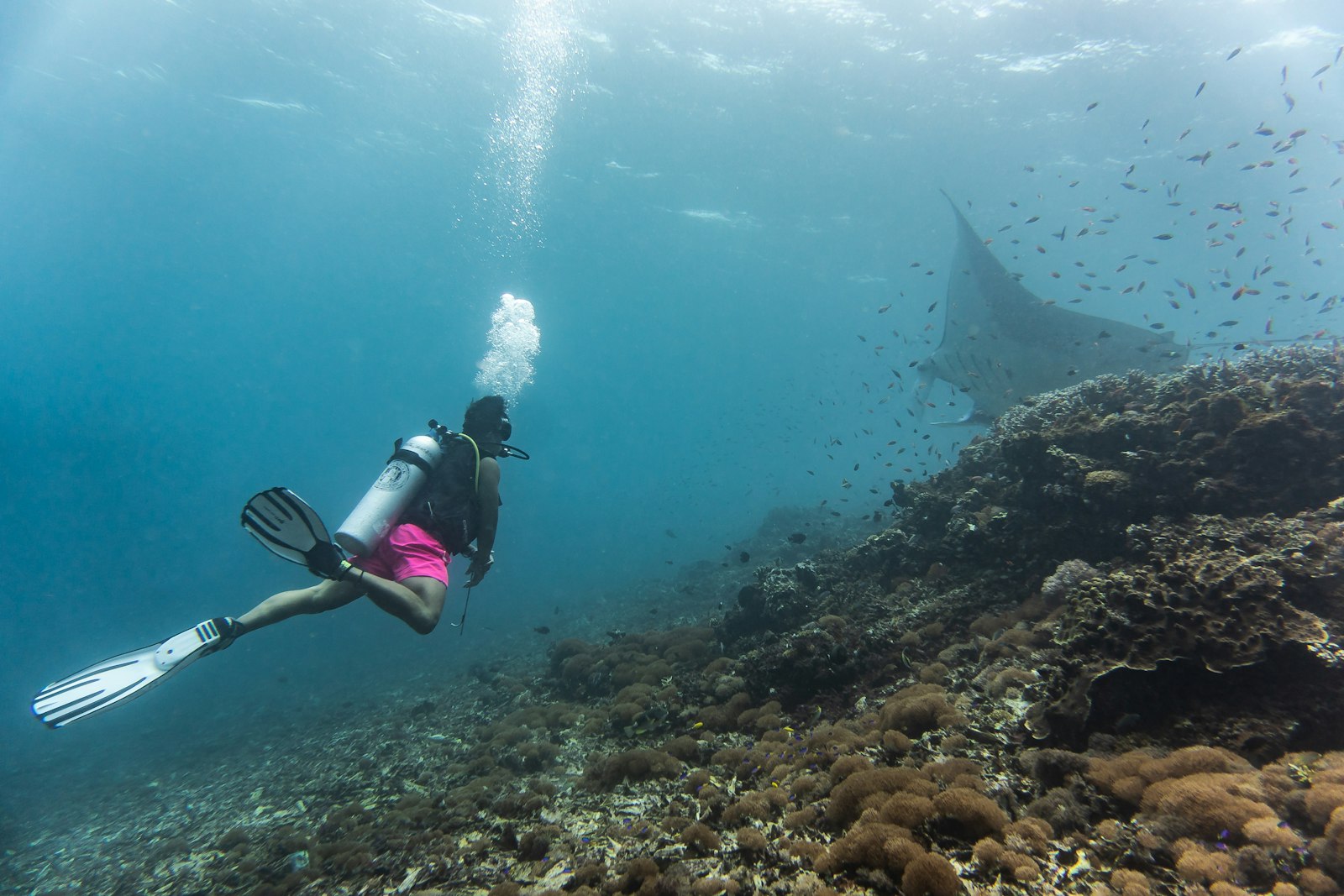
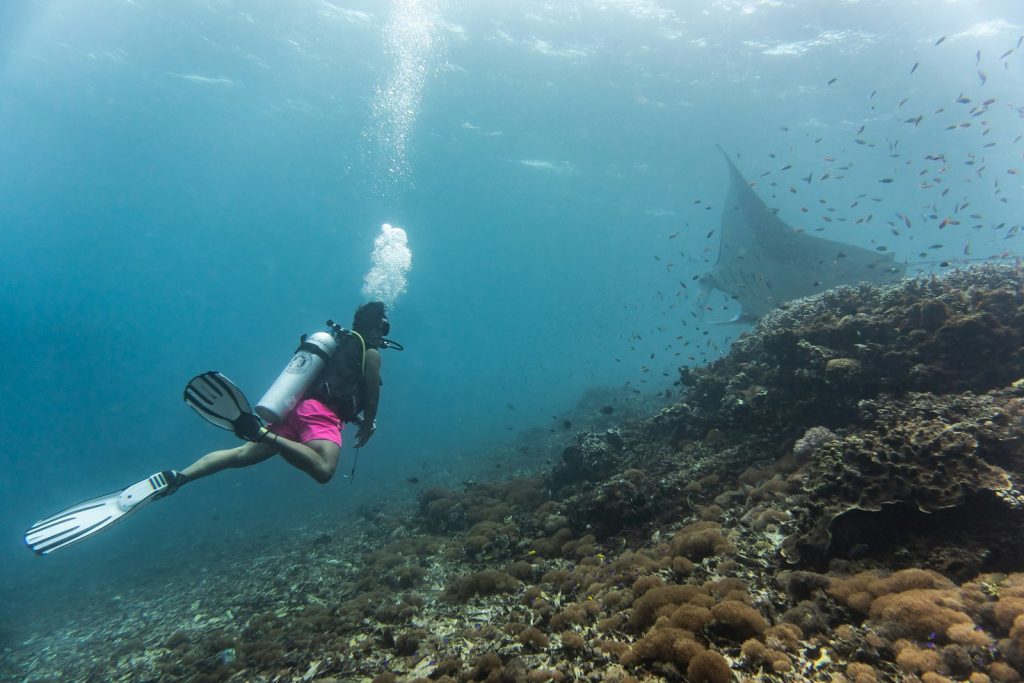
Komodo’s mantas, the shallow reef structures at sites like Tatawa Kecil, and the photographic possibilities at depth make freediving appealing. Breathing exercises for freediving in Komodo are genuinely part of the preparation any competent freediver uses: diaphragmatic activation, tidal volume extension, relaxation cycles before a breath-hold. But these techniques require proper instruction from qualified freediving instructors and must never be practised — especially breath-hold exercises — in or near water without a trained buddy present who is themselves qualified in freediving rescue and CPR.
Shallow-water blackout — the loss of consciousness that can occur during breath-hold diving without warning, typically as a diver ascends through the last few metres — is one of the leading causes of drowning among breath-hold swimmers worldwide. It is silent, extremely rapid, and unrecoverable without immediate in-water rescue. It can occur in apparently experienced freedivers on an otherwise unremarkable breath-hold. It has no reliable warning signs that the diver themselves can detect.
No blog, app, or self-guided practice programme is an adequate substitute for formal freediving instruction from a PADI Freediver, SSI Freediving, or Molchanovs-certified instructor who teaches you breath-hold technique alongside safety protocols and rescue skills. In the Komodo region, some liveaboard operators and dive centres do offer or can refer you to structured freediving courses [VERIFY directly with your operator for current offerings]. If freediving is your goal, invest in proper tuition first. The cost of a course is incomparably smaller than what can happen without one.
This is not caution for its own sake. It is the accurate description of the risk environment.
How Yoga and Breathwork Affect Air Consumption: What We Can Say Honestly
There is a version of wellness marketing that promises yoga will cut your air consumption in half and make you dolphin-like underwater. That version is not useful. Here is what the available evidence and diver experience actually support.
- Lower resting metabolic rate before the dive
- Regular yoga and breathwork practice reduces resting heart rate and baseline anxiety in many practitioners over time. A diver who enters the water at 60 beats per minute rather than 80 will consume oxygen more slowly. This is a general fitness and composure effect, not a dive-specific claim.
- Better breathing mechanics
- Yoga specifically develops awareness of diaphragmatic breathing over thoracic (chest) breathing. Diaphragmatic breaths move more volume per cycle and are metabolically less effortful than shallow chest breathing. For divers, this translates to fewer, fuller breaths — which directly correlates with slower tank consumption and less CO2 accumulation.
- Reduced muscle tension at depth
- Tight hips, a locked thoracic spine, and shoulder tension all consume oxygen through isometric muscular effort. Yoga mobility work that addresses these patterns can reduce the passive oxygen expenditure of staying neutrally buoyant at depth.
- What yoga and breathwork do NOT do
- They do not expand total lung capacity in ways that change your decompression physiology. They do not substitute for ear and sinus health that determines whether you can equalise comfortably. They do not replace buoyancy control training. And they do not provide any protection against the decompression sickness risk that exists independently of breathing efficiency.
Frame this as what it is: general wellbeing support that happens to have meaningful practical benefits for divers, not a performance system with guaranteed outcomes.
Diver Lung Capacity Yoga: A Practical Morning Sequence
The following is a simple 20-minute sequence suitable for a phinisi deck or hotel room on a dive morning. It is drawn from standard yoga and pranayama practice — not from any proprietary system — and it is light enough not to fatigue muscles before diving.
Five minutes — seated breathwork. Begin cross-legged or in a chair. Three rounds of nadi shodhana (alternate nostril) at a comfortable pace. Follow with two minutes of extended exhale breathing: inhale four counts, exhale six to eight counts. No breath holds.
Five minutes — spinal mobility. Cat-cow on hands and knees (eight rounds, slow). Seated thoracic twist, left and right (hold 45 seconds each side). Child’s pose with arms extended forward (90 seconds). These decompress the lumbar and thoracic regions compressed by sleeping in a bunk or sitting on gear bags.
Five minutes — hip and chest opening. Low lunge on each side, 60 seconds. Doorway or block-assisted chest opener, 60 seconds. Supine knees-to-chest with gentle rocking to massage the lumbar.
Five minutes — grounding close. Lie in savasana or sit quietly with eyes closed. Three intentional breaths. Brief mental rehearsal of the dive plan — not anxious review, but a simple, clear run-through of the briefed route, entry, safety stop, exit. Then get up and eat breakfast.
Nothing here requires a yoga mat. A folded sarong on a non-slip surface works. The sequence is designed to be done before the first cup of coffee and before gear setup begins, not as part of a structured retreat programme. For divers who want a more extended practice, our guide to yoga retreats in Komodo and Flores covers land-based and liveaboard options in detail.
After the Dive: Restorative Practice for Recovery
Post-dive recovery is a genuine wellness opportunity that few divers use deliberately. The standard liveaboard pattern is: surface, rinse gear, eat, sleep. That is reasonable, but a brief restorative practice between dive sessions can address the specific physical stress patterns of the day.
Water at depth in Komodo’s central and southern zones runs cooler than the surface — as low as 23–24°C in the south, with thermocline pockets at depth in the north reaching similar temperatures even in warmer months. Post-dive cold stress, combined with the physical exertion of drift diving and gear handling, means that muscles benefit from gentle movement rather than immediate horizontal collapse.
Fifteen minutes of restorative poses between morning and afternoon dives — supported fish, supine spinal twist, legs up the wall (or legs up the hull, on a phinisi) — are sufficient. This is not recovery yoga in the athletic-performance sense. It is basic parasympathetic activation between periods of physical and cognitive demand. See our full dive wellness retreat guide for how to build a complete recovery protocol around a multi-day Komodo liveaboard.
Finding Instruction in the Region
Structured breathwork and yoga instruction specifically for divers remains uncommon in Labuan Bajo, though the landscape is developing. A handful of relevant options are worth knowing about, with the candid note that all of these warrant direct verification before you book around them.
Several liveaboard operators in the Komodo corridor include yoga as part of their programme — Samara Liveaboard offers customisable wellness charters with onboard yoga instructors [VERIFY current availability], and SeaTrek Sailing Adventures publishes a wellness cruise product with daily yoga and meditation [VERIFY departure schedule]. These offerings vary significantly in instructor qualification and programme depth, so asking specific questions before booking matters more than the marketing description.
On land, Labuan Bajo has a small community yoga presence. Bajo Yoga, which describes itself as the first yoga service in the town and has operated since 2017, holds community sessions accessible to visitors [VERIFY current schedule]. A local RYT200-certified instructor active on Instagram (@niang_yogabajo) [VERIFY] offers private and group classes. Neither of these is a formal breathwork-for-divers programme, but either can provide a competent yoga foundation session before or after a dive day.
For freediving-specific breathwork tuition, the only reliable approach is to book through an operator running structured freediving courses with certified instructors. Ask your liveaboard or dive centre directly whether they offer freediving courses or can refer you to a provider who does [VERIFY with specific operator before travel].
No one can pay to change what we publish here; if you use our free concierge help and proceed with a partner or operator, they may pay us a referral fee at no extra cost to you. Our editorial position on this topic stays the same regardless.
Costs and Practical Planning
Breathwork and yoga for divers in Komodo can sit within any budget tier, because the foundational practice requires nothing more than 20 minutes and a flat surface. What costs money is structured instruction and the overall trip context in which you practise.
| Format | Approximate Cost | What You Get | Notes |
|---|---|---|---|
| Self-directed practice (deck or hotel room) | No additional cost | Your own sequence; no instruction | Effective if you already have a yoga or breathwork foundation |
| Drop-in class, Labuan Bajo local instructors | ~IDR 100,000–300,000/session estimated | Group yoga session, no dive-specific focus | Verify current offerings and pricing directly with Bajo Yoga or local instructors |
| Mid-range wellness liveaboard with yoga included | ~USD 200–350/person/day all-in | Daily group yoga on deck; instructor quality varies | Confirm instructor qualification and session guarantee before booking |
| Luxury or private liveaboard with dedicated yoga/breathwork | ~USD 400–1,000+/person/night | Named instructor, structured programming, smaller group | Pricing inferred from comparable Indonesian luxury liveaboard market; request specific quote |
| Freediving course (foundational level) | USD 200–400+ estimated for entry course | Certified instruction, safety protocol, breath-hold technique in water with supervision | Verify current providers in Labuan Bajo or Komodo; never attempt breath-hold practice without this |
Park entry costs apply for all in-water activity inside Komodo National Park. As of 2025–2026, foreign nationals pay IDR 250,000 per person per day, IDR 25,000 per diver per day, and IDR 25,000 in harbour fees. These are per the daily fee model currently in effect; the daily visitor cap of 1,000 across all zones also applies, with advance booking via the SiOra system mandatory. Operators recommend booking two to four months ahead for peak season (June through September).
To plan a Komodo trip that integrates breathwork and yoga alongside diving, reach out via our enquiry form or WhatsApp at +62 811 3823 875. We can help match your experience level, timeline, and goals to the operators and formats most likely to deliver what you are actually looking for.
Frequently Asked Questions
Can breathwork actually reduce my air consumption while diving in Komodo?
It can help, though the mechanism is indirect. Breathwork and yoga practice that lowers your resting heart rate, reduces muscle tension, and trains diaphragmatic breathing over shallow chest breathing supports the physiological conditions that correlate with slower air consumption. The direct factors — buoyancy control, thermal exposure, physical fitness level, and composure under current stress — are improved over time through both dive experience and a regular calm-breath practice. No breathwork programme guarantees a specific outcome, and results vary significantly between individuals.
Is yoga useful for equalisation problems?
Yoga addresses some of the musculoskeletal contributors to difficult equalisation — particularly thoracic rigidity and neck tension that can create compensatory pressure patterns in the head. It does not address the anatomical or pathological causes of Eustachian tube dysfunction, sinus inflammation, or middle ear conditions. If you have persistent equalisation difficulty, a dive physician or ENT specialist is the right starting point, not a yoga instructor.
What is the difference between yoga breathwork and freediving breathwork — and why does it matter?
Yoga pranayama is practised on the surface and is designed for breathing regulation and nervous system modulation, not for extended breath-hold diving. Freediving breathwork is a specialised discipline that prepares the body and mind for extended voluntary apnea in water, and it involves techniques — including specific ventilation patterns before a breath-hold — that carry genuine physiological risk if applied incorrectly. The two are not interchangeable. Yoga pranayama is generally safe for recreational divers to explore with basic guidance. Freediving breathwork must be taught by qualified freediving instructors and practised only in water with a trained safety buddy present. Never attempt breath-hold exercises near or in water unsupervised, regardless of how much yoga experience you have.
Do I need to do yoga before every dive, or is occasional practice useful?
Occasional practice still delivers value — primarily in the form of increased body awareness and improved general breath mechanics. The most consistent benefits for air consumption and composure come from a regular practice maintained at home before the trip and continued with even a short daily session during the dive week. Five to ten minutes of breathwork or gentle mobility work each dive morning is more effective than a single long session at the beginning of the week.
Is it safe to do breathwork or yoga on a boat with equipment around?
Standard gentle yoga and pranayama are safe on a boat deck when the vessel is at anchor, provided the surface is non-slip and you are not attempting balance-intensive poses in significant swell. Avoid inversions, advanced standing balance postures, and any practice that removes your visual orientation to the horizon if you are prone to motion sickness. Keep equipment secured well away from your practice space. Anyone with an inner ear condition or active vertigo should stay with seated and floor-based practice only.